 Start
Start
 Finish
Band Standing Straight Leg Raise
Stand upright facing away from an anchored resistance band, with the band secured around one ankle and your hands on your hip and a stable surface for balance. Keeping your core engaged and standing leg slightly bent, slowly lift your banded leg straight in front of you until it’s parallel to the ground, then lower it back down with control. Maintain a straight leg and avoid swinging for best results.
- Target muscles
- Upper legs
- Also works
- Glutes, Lower legs
- Equipment
- Resistance bands
- Training style
- Home, Gym-based, Mobility and recovery
- Logged as
- Weight and reps
- Popularity
- 75 of 100
Band Standing Straight Leg Raise: how to do it
- Secure a resistance band to a sturdy anchor point at ankle height.
- Attach the other end of the band around one ankle.
- Stand upright with your feet hip-width apart, facing away from the anchor point.
- Place one hand on your hip and the other hand on a stable surface for balance, such as a wall or a sturdy object.
- Engage your core and keep your standing leg slightly bent for stability.
- Slowly lift the leg with the band straight in front of you, keeping it extended and controlled.
- Raise the leg until it is parallel to the ground or as high as your flexibility allows, ensuring you feel the contraction in your hip flexors and quadriceps.
- Pause briefly at the top of the movement.
- Slowly lower the leg back to the starting position without letting the band lose tension.
- Repeat for the desired number of repetitions, then switch to the other leg.
Common mistakes
Avoid swinging your leg or using momentum, as this reduces muscle activation. Keep your core tight, hips square, and maintain a slight bend in the standing leg to prevent strain and ensure proper form.
Alternatives
More Upper legs exercises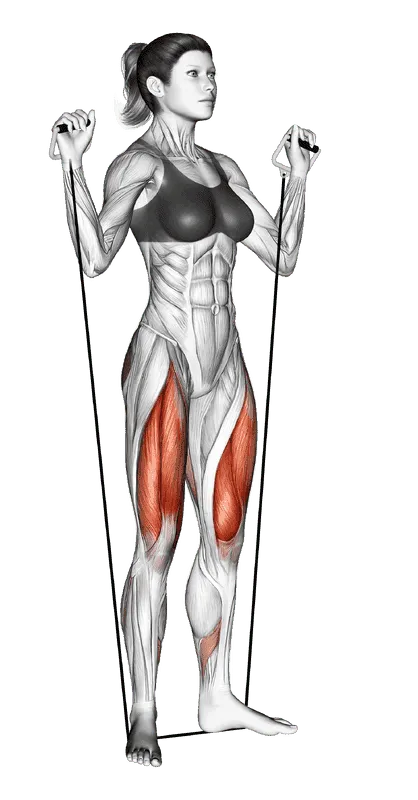






Questions about Band Standing Straight Leg Raise
What muscles does the Band Standing Straight Leg Raise work?
This exercise primarily targets the upper legs, especially the quadriceps, while also engaging the glutes and lower leg muscles for stability. The core muscles play a supportive role by maintaining balance and posture during the movement.
Do I need resistance bands for the Standing Straight Leg Raise, and are there alternatives?
Resistance bands are recommended because they provide constant tension throughout the lift, making the exercise effective for strength and toning. If you don’t have bands, you can use ankle weights or perform the movement without equipment for a mobility-focused variation.
Is the Band Standing Straight Leg Raise suitable for beginners?
Yes, beginners can perform this exercise as long as they use a light resistance band and focus on slow, controlled movements. It’s also a safe way to improve lower body strength without heavy loads, making it ideal for home workouts.
What are common mistakes to avoid during the Band Standing Straight Leg Raise?
Avoid swinging your leg or using momentum, as this reduces muscle activation. Keep your core tight, hips square, and maintain a slight bend in the standing leg to prevent strain and ensure proper form.
How many sets and reps should I do for this exercise?
For strength and toning, aim for 2–3 sets of 10–15 reps per leg, using a resistance band that challenges you without compromising form. Rest for about 30–60 seconds between sets to maintain quality performance.
Are there any safety tips for the Band Standing Straight Leg Raise?
Ensure the band is securely anchored and check it for wear before use to prevent accidents. Keep movements controlled, avoid locking your knee at the top of the lift, and hold onto a stable surface if you need extra balance.
What variations can I try to make the Band Standing Straight Leg Raise more challenging?
You can increase the band resistance, slow down the tempo, or add a brief hold at the top for an isometric challenge. Performing the exercise without holding onto support can also intensify balance and core engagement.