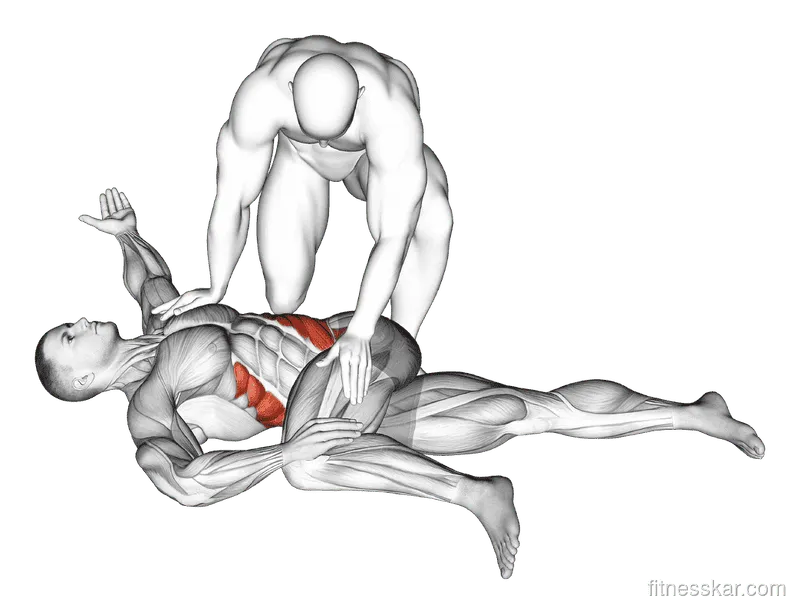
Assisted Oblique, Glute Minimus, and Medius Stretch
Lie on your back with arms out to your sides, one knee bent and foot flat, the other leg extended. With a partner stabilizing your rib cage and gently guiding your bent knee, rotate your leg across your body until you feel a stretch in your obliques and glutes. Keep your shoulders flat on the floor throughout the stretch.
- Target muscles
- Obliques, Glutes
- Equipment
- Bodyweight
- Training style
- Mobility and recovery
- Logged as
- Seconds
- Popularity
- 20 of 100
Assisted Oblique, Glute Minimus, and Medius Stretch: how to do it
- Lie face up on the floor with your arms out to your sides, perpendicular to your torso.
- Bend one knee and place your foot flat on the floor. Keep the other leg extended.
- Have a partner kneel beside your bent leg, facing your feet.
- Have your partner place one hand on your rib cage and the other hand on your bent knee, to stabilize your body.
- Keeping your bent knee bent, rotate your leg across your body towards the floor. Your partner should assist by gently guiding your knee towards the floor with their hand, and prevent your rib cage from lifting with their other hand. You should feel a stretch in your obliques, glute minimus, and glute medius on the side of your bent leg.
- Hold the stretch for the desired amount of time.
- Return to the starting position and repeat with the other leg.
Sets and reps (general guidance)
| Goal | Sets | Reps | Load |
|---|---|---|---|
| Strength | 3 to 5 | 3 to 6 | Heavy, full rest |
| Muscle and endurance | 3 to 4 | 8 to 12 | Moderate, perfect form |
Common mistakes
One common mistake is allowing the shoulders to lift off the floor, which reduces the stretch in the obliques. Another is rotating too aggressively, which can strain the lower back; keep the movement slow and controlled.
Alternatives
More Obliques exercises
Questions about Assisted Oblique, Glute Minimus, and Medius Stretch
What muscles does the Assisted Oblique, Glute Minimus, and Medius Stretch target?
This stretch primarily targets the obliques and the gluteus minimus and medius muscles. It helps improve flexibility and mobility in your core and hips, making it especially useful after lower body or abdominal workouts.
Do I need any equipment for this stretch?
No special equipment is required—it's a bodyweight-only mobility exercise. You will need a partner to assist and guide the stretch, but if you're alone, you can use a resistance band or towel to simulate the guided movement.
Is this stretch suitable for beginners?
Yes, this assisted stretch can be performed safely by beginners as long as the range of motion is controlled and there is no pain. Beginners should start with a gentle rotation and gradually increase intensity as flexibility improves.
What are common mistakes to avoid during the Assisted Oblique, Glute Minimus, and Medius Stretch?
One common mistake is allowing the shoulders to lift off the floor, which reduces the stretch in the obliques. Another is rotating too aggressively, which can strain the lower back; keep the movement slow and controlled.
How long should I hold this stretch for best results?
Hold the stretch for 20–40 seconds per side, focusing on deep, steady breathing. Repeat for 2–3 rounds to maximize flexibility benefits while avoiding overstretching.
What safety tips should I follow when doing this assisted stretch?
Always communicate with your partner to ensure the stretch intensity is comfortable. Avoid forcing the leg across the body and stop immediately if you feel sharp pain or discomfort in the hips or lower back.
Are there variations or modifications of this stretch for different flexibility levels?
Yes, advanced variations include increasing the leg rotation angle or adding gentle pulsing for a deeper stretch. For limited flexibility, keep the bent knee closer to the floor and use a towel or strap instead of partner assistance.