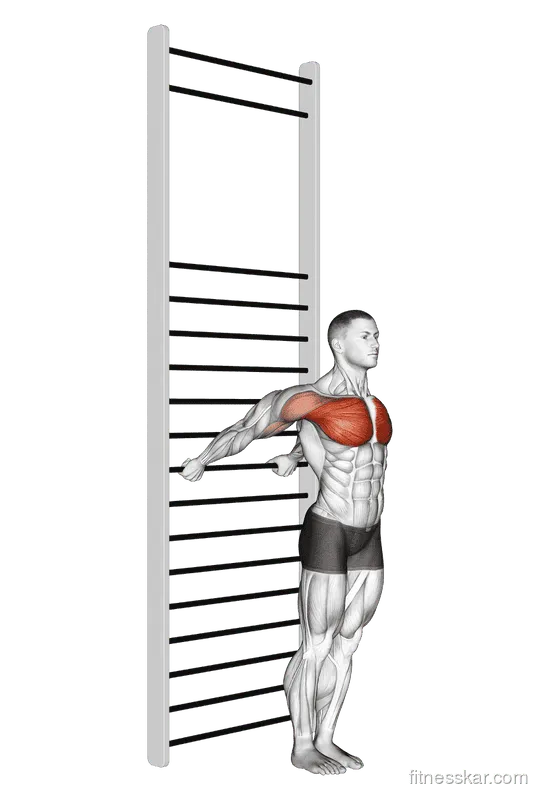
Standing Chest Stretch (with Training Wall Bars)
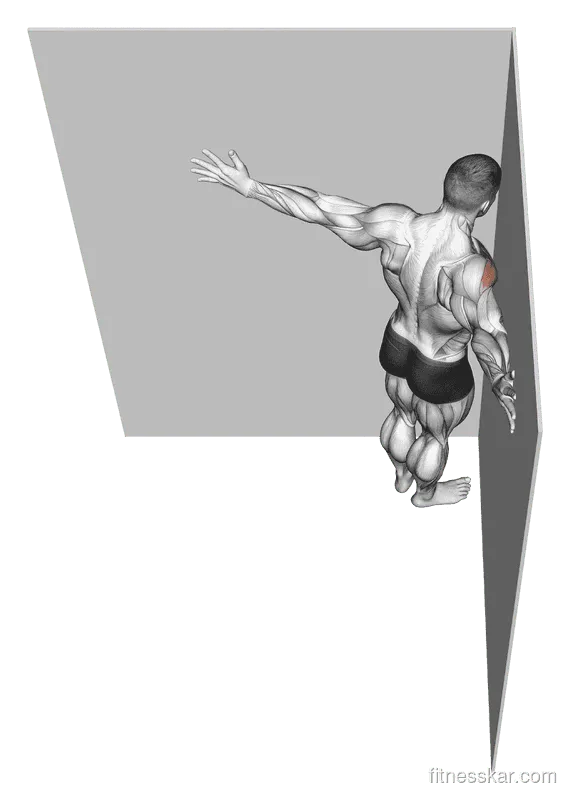
Stand facing away from the wall bars and place one hand on a bar at shoulder height with your arm extended straight behind you. Keeping your posture upright, gently rotate your torso away from the anchored arm until you feel a stretch across your chest and shoulder. Maintain steady breathing and avoid arching your back during the stretch.
- Target muscles
- Chest
- Also works
- Shoulders
- Equipment
- Other
- Training style
- Mobility and recovery, Gym-based
- Logged as
- Seconds
- Popularity
- 75 of 100
Standing Chest Stretch (with Training Wall Bars): how to do it
- Stand facing away from a set of training wall bars or a similar structure.
- Place one hand on the bar at shoulder height or slightly below, with your arm extended straight behind you.
- Keep your feet firmly planted on the ground, standing upright with a straight posture.
- Slowly rotate your torso away from the arm holding the bar, feeling a stretch in your chest and shoulder.
- Hold the stretch for the desired duration, ensuring you maintain a steady and controlled breathing pattern.
- Repeat the stretch on the opposite side by switching arms.
Sets and reps (general guidance)
| Goal | Sets | Reps | Load |
|---|---|---|---|
| Strength | 3 to 5 | 3 to 6 | Heavy, full rest |
| Muscle and endurance | 3 to 4 | 8 to 12 | Moderate, perfect form |
Common mistakes
Avoid arching your lower back, locking your elbow joint excessively, or twisting too aggressively. Keep your posture upright, rotate smoothly, and focus on controlled breathing to prevent strain on the shoulder joint.
Alternatives
More Chest exercises

Questions about Standing Chest Stretch (with Training Wall Bars)
What muscles does the Standing Chest Stretch with training wall bars work?
This stretch primarily targets the pectoral muscles in your chest, helping to improve flexibility and mobility. It also engages the front portions of your shoulders, promoting better posture and reducing muscle tightness from pressing exercises.
Do I need training wall bars for this chest stretch, or are there alternatives?
While wall bars provide a stable and convenient anchor for the arm, you can use a doorway, sturdy railing, or even a squat rack upright instead. The key is to find a fixed vertical surface at shoulder height that allows you to extend your arm safely behind you.
Is the Standing Chest Stretch suitable for beginners?
Yes, this is a beginner-friendly stretch as long as you maintain proper form and avoid forcing the movement. Start with a gentle rotation until you feel a mild stretch and gradually increase the intensity as your flexibility improves.
What are common mistakes to avoid with the Standing Chest Stretch?
Avoid arching your lower back, locking your elbow joint excessively, or twisting too aggressively. Keep your posture upright, rotate smoothly, and focus on controlled breathing to prevent strain on the shoulder joint.
How long should I hold the Standing Chest Stretch for best results?
For mobility benefits, hold the stretch for 20–30 seconds per side, repeating 2–3 times. Maintain steady breathing throughout and stop immediately if you feel sharp pain instead of a gentle pulling sensation.
Are there any safety tips for performing this chest stretch?
Always warm up before stretching to avoid injury, especially if your muscles are tight from recent training. Keep movements controlled, avoid overstretching, and ensure your anchor point is stable to prevent slips.
Can I modify the Standing Chest Stretch for greater intensity?
Yes, you can increase intensity by stepping slightly forward after initiating the stretch or by placing your hand slightly higher or lower on the wall bars. Small adjustments in arm position change the angle and emphasis on different chest fibers.