 Start
Start
 Finish
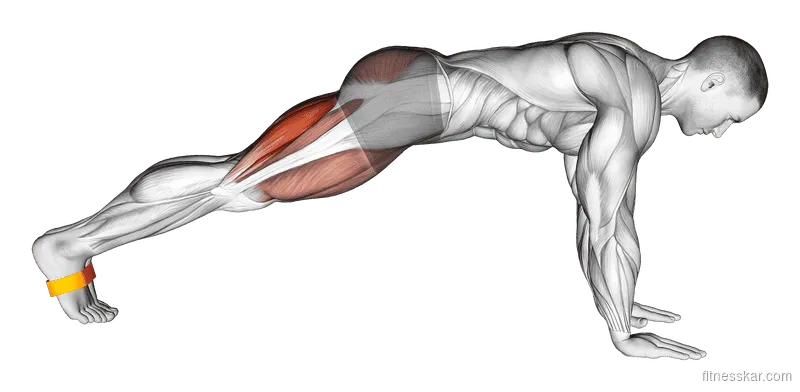
Resistance Band Plank March
Start in a high plank position with a resistance band around your ankles, keeping your body in a straight line and core engaged. Alternate lifting each knee toward your chest in a controlled marching motion, maintaining tension on the band. Keep your hips steady and avoid letting them sag or rotate throughout the exercise.
- Target muscles
- Abs, Upper legs
- Also works
- Shoulders, Glutes
- Equipment
- Resistance bands, Bodyweight
- Training style
- Home, Calisthenics
- Logged as
- Reps
- Popularity
- 75 of 100
Resistance Band Plank March: how to do it
- Begin in a high plank position with your hands directly under your shoulders and your body forming a straight line from head to heels.
- Place a resistance band around your ankles, ensuring it is secure but not overly tight.
- Engage your core muscles to stabilize your body and prevent your hips from sagging or rotating.
- Lift your right foot off the ground and bring your knee toward your chest in a controlled motion, keeping tension on the resistance band.
- Slowly return your right foot to the starting position while maintaining the plank position.
- Repeat the movement with your left foot, bringing your left knee toward your chest.
- Continue alternating legs in a marching motion, maintaining proper form and core engagement throughout the exercise.
Common mistakes
Avoid letting your hips sag or rotate, as this reduces core engagement and increases injury risk. Keep your shoulders stacked over your wrists, maintain a straight line from head to heels, and control the marching motion.
Alternatives
More Abs exercises
Questions about Resistance Band Plank March
What muscles does the Resistance Band Plank March work?
The Resistance Band Plank March primarily targets your abs and upper legs, while also engaging your shoulders and glutes for stability. It’s a great full-body core exercise that challenges both strength and balance.
Do I need special equipment for the Resistance Band Plank March?
You’ll need a looped resistance band, ideally medium tension, placed around your ankles. If you don’t have a band, you can still perform the movement bodyweight-only for core activation, though the lower body engagement will be reduced.
Is the Resistance Band Plank March suitable for beginners?
Yes, beginners can perform a modified version without resistance bands to focus on form. Start with shorter holds and slower marches to build core stability, then add a resistance band once you feel confident with your technique.
What are common mistakes to avoid when doing the Resistance Band Plank March?
Avoid letting your hips sag or rotate, as this reduces core engagement and increases injury risk. Keep your shoulders stacked over your wrists, maintain a straight line from head to heels, and control the marching motion.
How many sets and reps should I do for the Resistance Band Plank March?
Aim for 3 sets of 10–15 marches per leg, or perform the movement for 30–45 seconds per set. Keep rest periods short (30–60 seconds) to maintain core activation and cardiovascular benefits.
Are there safety considerations for the Resistance Band Plank March?
Ensure your wrists, shoulders, and hips are in proper alignment to minimize strain. Use a non-slip surface and choose a band tension you can control without compromising form to avoid overloading your joints.
What variations can I try for the Resistance Band Plank March?
To increase difficulty, use a heavier resistance band or perform the march on a stability ball to challenge balance. For an easier option, do the move from a forearm plank position or reduce the range of knee lifts.