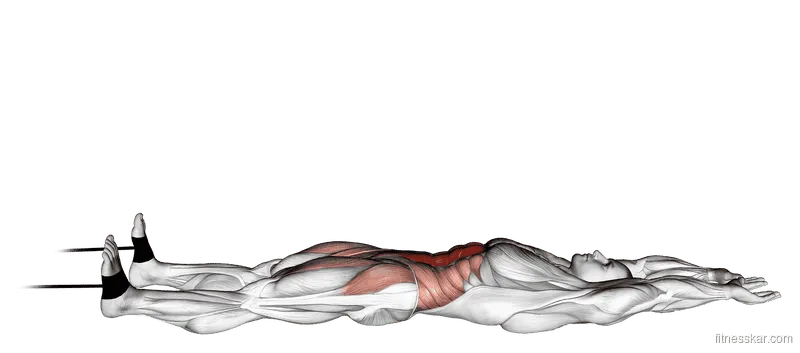
 Start
Start
 Finish
Band V-Up
Lie on your back with arms extended overhead holding a resistance band, and the other end looped around your feet. Keeping your legs straight and core engaged, lift your arms and legs together to meet above your hips, then lower back down with control. Focus on keeping your lower back pressed into the floor throughout the movement.
- Target muscles
- Abs, Upper abs
- Also works
- Obliques, Lower abs
- Equipment
- Resistance bands
- Training style
- Home
- Logged as
- Reps
- Popularity
- 20 of 100
Band V-Up: how to do it
- Lie face up on the floor with your arms overhead, holding a resistance band in both hands. Secure the other end of the band around your feet.
- Keep your legs straight, engage your core, and simultaneously lift your arms and legs off the ground, bringing your hands towards your feet.
- Slowly lower back down to the starting position, maintaining control throughout the movement.
Common mistakes
Avoid pulling with your arms instead of engaging your core, arching your lower back, or using momentum to lift. Keep your lower back pressed firmly into the floor and focus on a controlled lift and descent.
Alternatives
More Abs exercises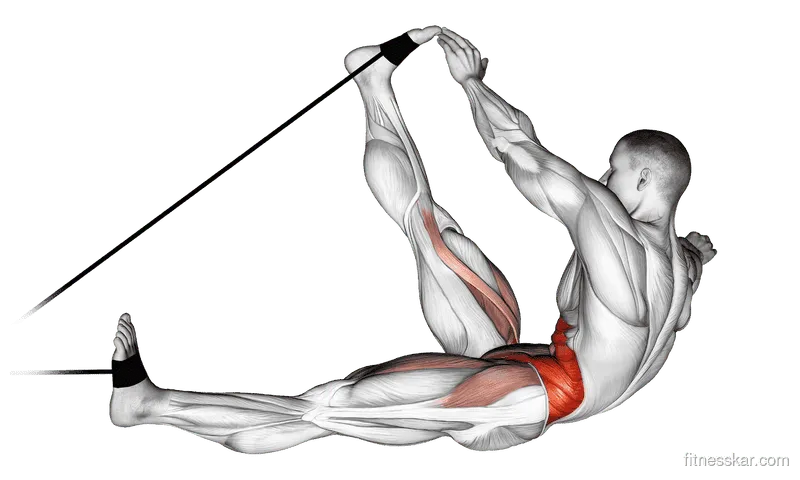

Questions about Band V-Up
What muscles do Band V-Ups work?
Band V-Ups primarily target the abs, especially the upper abs, while also engaging the lower abs and obliques. The resistance band increases tension throughout the movement, making your core work harder to stabilize.
What equipment do I need for Band V-Ups, and are there alternatives?
You’ll need a resistance band for Band V-Ups, ideally a light to medium tension band for controlled movement. If you don’t have a band, you can perform a standard bodyweight V-Up or use a towel to mimic light resistance.
Are Band V-Ups suitable for beginners?
Beginners can do Band V-Ups with a lighter resistance band or by bending their knees to reduce strain on the lower back. Start with slow, controlled movements to learn proper form before increasing intensity.
What are common mistakes to avoid during Band V-Ups?
Avoid pulling with your arms instead of engaging your core, arching your lower back, or using momentum to lift. Keep your lower back pressed firmly into the floor and focus on a controlled lift and descent.
How many sets and reps of Band V-Ups should I do?
Aim for 3 sets of 10–15 reps, resting 30–60 seconds between sets. Adjust the resistance band tension and reps based on your core strength and fitness level.
Are there safety tips for performing Band V-Ups?
Ensure the band is securely anchored around your feet and hands to prevent it from snapping back. Maintain a neutral spine and engage your core throughout to protect your lower back.
What variations can I try for Band V-Ups?
You can perform single-leg Band V-Ups for more focus on each side, or add a rotational twist at the top to work the obliques more. Using a heavier resistance band will increase the difficulty and muscle activation.