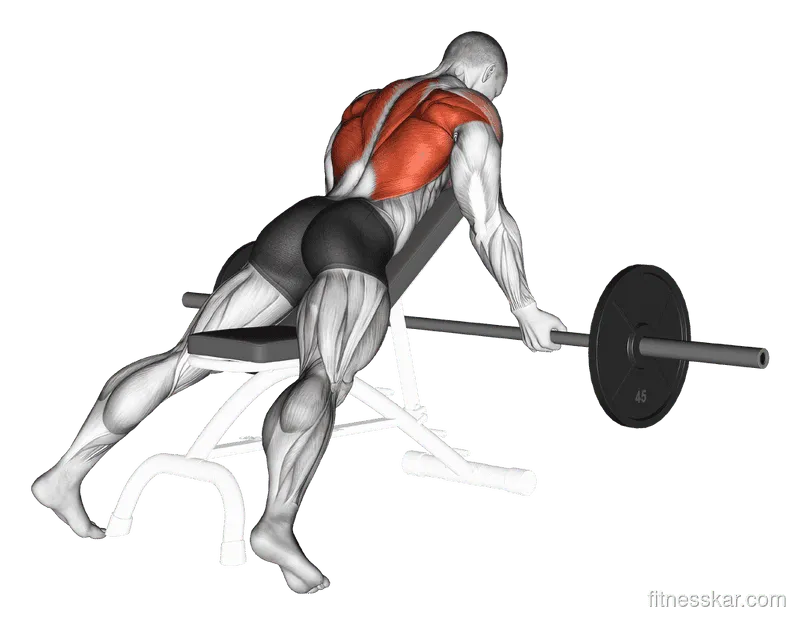
 Start
Start
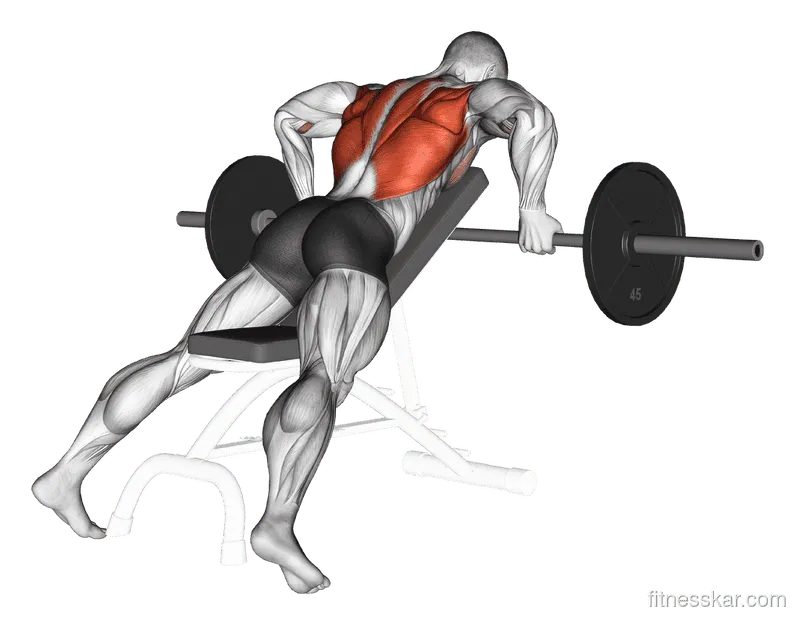 Finish
Barbell Reverse Grip Incline Bench Row
Lie face down on an incline bench with your feet on the floor and grasp a barbell below you using a shoulder-width underhand grip. Pull the barbell up toward your chest, keeping your elbows close to your body and squeezing your shoulder blades together at the top. Lower the barbell with control, fully extending your arms before repeating.
- Target muscles
- Back
- Also works
- Biceps, Shoulders
- Equipment
- Bench, Barbell plus plates
- Training style
- Gym-based
- Logged as
- Weight and reps
- Popularity
- 85 of 100
Barbell Reverse Grip Incline Bench Row: how to do it
- Set an incline bench to a comfortable angle, typically around 30-45 degrees, and position it securely.
- Place a barbell on the floor in front of the bench.
- Lie face down on the incline bench with your chest and stomach supported by the bench pad. Your feet should be firmly planted on the floor for stability.
- Reach down and grab the barbell with a reverse (underhand) grip, keeping your hands shoulder-width apart.
- Start with your arms fully extended and the barbell hanging straight down.
- Engage your back muscles and pull the barbell towards your chest, keeping your elbows close to your body.
- Squeeze your shoulder blades together at the top of the movement and hold for a brief moment.
- Slowly lower the barbell back to the starting position, fully extending your arms.
- Repeat for the desired number of repetitions, maintaining proper form throughout the exercise.
Common mistakes
Common errors include rounding the back, using momentum instead of muscle control, and flaring the elbows out too much. To avoid injury and maximize gains, keep your chest firmly on the bench, pull with your back muscles, and squeeze your shoulder blades at the top.
Alternatives
More Back exercises


Questions about Barbell Reverse Grip Incline Bench Row
What muscles does the Barbell Reverse Grip Incline Bench Row work?
This exercise primarily targets your upper and middle back, including the rhomboids and lats. It also engages your biceps and rear deltoids as secondary muscles, making it effective for building both pulling strength and upper body thickness.
What equipment do I need for the Barbell Reverse Grip Incline Bench Row?
You will need an incline bench and a barbell to perform this movement correctly. If a barbell isn’t available, you can use dumbbells with the same reverse grip to achieve a similar muscle activation.
Is the Barbell Reverse Grip Incline Bench Row suitable for beginners?
Yes, beginners can perform this exercise if they start with a lighter weight to learn proper form. Ensure the bench angle is comfortable and focus on slow, controlled movements before progressing to heavier loads.
What are common mistakes when performing the Barbell Reverse Grip Incline Bench Row?
Common errors include rounding the back, using momentum instead of muscle control, and flaring the elbows out too much. To avoid injury and maximize gains, keep your chest firmly on the bench, pull with your back muscles, and squeeze your shoulder blades at the top.
How many sets and reps should I do for the Barbell Reverse Grip Incline Bench Row?
For strength and muscle growth, aim for 3–4 sets of 8–12 reps with moderate to heavy weight. If your goal is endurance, use lighter weight and perform 2–3 sets of 12–15 reps while maintaining perfect form.
What safety considerations should I keep in mind for this exercise?
Always keep your core engaged to protect your lower back and avoid jerking the barbell. Use a controlled motion throughout the lift and ensure the bench is stable before starting the exercise.
Are there variations of the Barbell Reverse Grip Incline Bench Row I can try?
Yes, you can use dumbbells instead of a barbell for increased range of motion, or adjust your grip width to target slightly different parts of your back and arms. You can also try a neutral grip for reduced wrist strain.