
Standing Leg Resting Hip Stretch
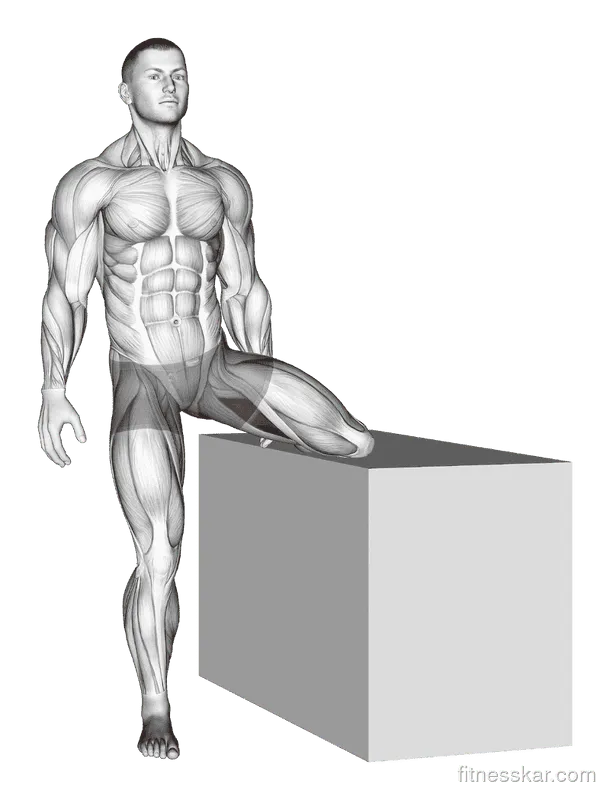
Stand upright next to a bench or chair for support and place one ankle across the opposite thigh, forming a figure-four shape. Keeping your back straight, gently bend your standing leg to lower your hips until you feel a stretch in your hip and glute. Hold the position, ensuring your lifted knee points outward.
- Target muscles
- Glutes
- Also works
- Hips, Lower legs
- Equipment
- Bench
- Training style
- Mobility and recovery, Home, Yoga and Pilates
- Logged as
- Seconds
- Popularity
- 75 of 100
Standing Leg Resting Hip Stretch: how to do it
- Stand upright next to a sturdy bench or chair for support.
- Place one hand on the bench or chair to maintain balance.
- Lift one leg and rest the ankle of the lifted leg on the opposite thigh, forming a figure-four shape.
- Ensure the knee of the lifted leg is bent outward to stretch the hip.
- Slowly lower your hips by bending the standing leg slightly, keeping your back straight.
- Hold the stretch for the desired duration, feeling the stretch in the hip and glute area.
- Return to the starting position and repeat on the other side.
Sets and reps (general guidance)
| Goal | Sets | Reps | Load |
|---|---|---|---|
| Strength | 3 to 5 | 3 to 6 | Heavy, full rest |
| Muscle and endurance | 3 to 4 | 8 to 12 | Moderate, perfect form |
Common mistakes
Avoid rounding your back or letting your lifted knee collapse inward, as this reduces the effectiveness of the stretch. Keep your torso upright, engage your core for stability, and bend from your hips rather than your lower back.
Alternatives
More Glutes exercises
Questions about Standing Leg Resting Hip Stretch
Which muscles does the Standing Leg Resting Hip Stretch target?
This stretch primarily works the glutes, helping release tension and improve mobility. It also engages the hips and lower legs as secondary muscles, promoting flexibility and recovery after workouts or prolonged sitting.
Do I need a bench to perform the Standing Leg Resting Hip Stretch?
A bench is ideal because it provides stable support for your leg, but you can also use a sturdy chair, low table, or any surface around knee height. The key is using a stable support so you can focus on balance and proper hip alignment.
Is the Standing Leg Resting Hip Stretch suitable for beginners?
Yes, this is a beginner-friendly stretch as long as you maintain balance and avoid forcing the leg position. Beginners should start with a shallow bend in the supporting leg and gradually increase depth as flexibility improves.
What are common mistakes to avoid during the Standing Leg Resting Hip Stretch?
Avoid rounding your back or letting your lifted knee collapse inward, as this reduces the effectiveness of the stretch. Keep your torso upright, engage your core for stability, and bend from your hips rather than your lower back.
How long should I hold the Standing Leg Resting Hip Stretch for best results?
Hold each side for 20–40 seconds, focusing on slow, deep breathing during the stretch. Repeat 2–3 times per side for optimal hip mobility and glute release.
What safety tips should I follow for the Standing Leg Resting Hip Stretch?
Always perform this stretch on a stable surface to prevent slipping, and avoid pushing into pain—mild tension is fine, sharp discomfort is not. Keep your core engaged and move slowly in and out of the stretch to protect your joints.
Are there variations of the Standing Leg Resting Hip Stretch I can try?
Yes, you can increase intensity by lowering deeper into the supporting leg or leaning slightly forward to enhance the glute stretch. For a seated version, perform the figure-four position on a chair and gently lean forward over your crossed leg.