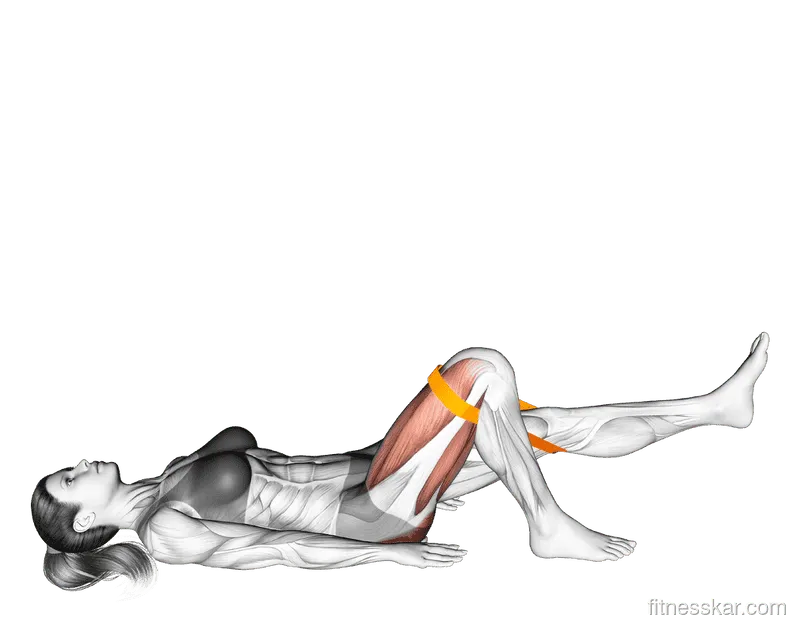
 Start
Start
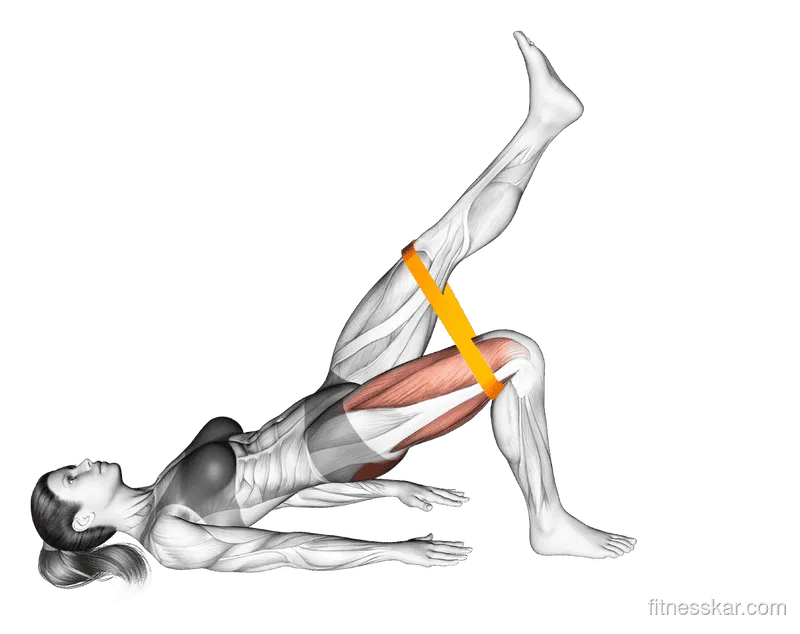 Finish
Resistance Band One Leg Glute Bridge With Straight Leg
Lie on your back with knees bent, feet flat, and a resistance band around your thighs. Extend one leg straight up, then press through your heel to lift your hips, squeezing your glutes and keeping the band taut. Lower your hips back down with control, maintaining level hips throughout.
- Target muscles
- Glutes
- Also works
- Upper legs
- Equipment
- Resistance bands, Bodyweight
- Training style
- Home
- Logged as
- Reps
- Popularity
- 60 of 100
Resistance Band One Leg Glute Bridge With Straight Leg: how to do it
- Lie on your back with your knees bent and feet flat on the floor. Place a resistance band around your thighs, just above your knees.
- Extend one leg straight up towards the ceiling, keeping your core engaged and your hips level.
- Push through your heels and lift your hips off the ground, squeezing your glutes at the top of the movement. Ensure the band remains taut throughout the exercise.
- Slowly lower your hips back down to the ground.
- Repeat for the desired number of repetitions, then switch legs.
Common mistakes
A common error is letting the hips rotate or drop on one side, which reduces glute engagement and can strain the lower back. Also avoid pushing through your toes—instead, press through your heel to maintain proper activation in the glutes.
Alternatives
More Glutes exercises
Questions about Resistance Band One Leg Glute Bridge With Straight Leg
What muscles does the Resistance Band One Leg Glute Bridge With Straight Leg work?
This exercise primarily targets the glute muscles, especially the gluteus maximus, while also engaging the hamstrings and quadriceps as secondary movers. The resistance band increases activation of the hip abductors, helping to build strength and stability across the hips.
Do I need a resistance band for the One Leg Glute Bridge or can I do it without?
A resistance band helps add extra tension to the glutes and abductors, making the exercise more effective. You can perform the movement without a band, but you may get less muscle activation around the hips—if you lack a band, focus on controlled form and slow tempo to increase difficulty.
Is the Resistance Band One Leg Glute Bridge With Straight Leg suitable for beginners?
It can be performed by beginners as long as they have basic core strength and hip mobility. New exercisers may want to start with a regular two-leg glute bridge or one-leg glute bridge without a band, then progress to using resistance for added challenge.
What are common mistakes to avoid during the Resistance Band One Leg Glute Bridge?
A common error is letting the hips rotate or drop on one side, which reduces glute engagement and can strain the lower back. Also avoid pushing through your toes—instead, press through your heel to maintain proper activation in the glutes.
How many sets and reps should I do for the One Leg Glute Bridge with a resistance band?
For strength and tone, aim for 3 sets of 10–15 controlled reps per leg, focusing on a full range of motion and strong glute squeeze at the top. Rest for 30–60 seconds between sets, or less if you’re training endurance.
What are the safety tips for performing the Resistance Band One Leg Glute Bridge?
Keep your core engaged to protect your lower back and avoid overarching the spine. Ensure the resistance band is secure but not overly tight, and maintain slow, controlled movements to reduce the risk of hip or hamstring strain.
Are there variations of the Resistance Band One Leg Glute Bridge I can try?
Yes—variations include holding the top position for 3–5 seconds to increase time under tension, using a heavier band for more resistance, or performing the movement with your elevated leg slightly angled to work different parts of the glutes. You can also try placing your foot on a step or bench for a greater range of motion.