 Start
Start
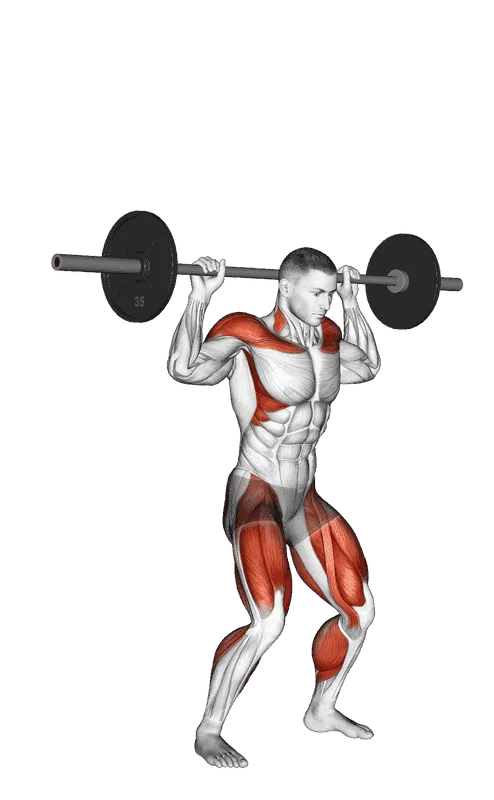 Finish
Barbell Heaving Snatch Balance
Start standing with a barbell across your upper back and a wide grip. Dip your knees, then explosively drive upward and drop into a deep squat, simultaneously pressing the bar overhead with locked arms. Keep your core tight and maintain balance before standing up with the bar still overhead.
- Target muscles
- Shoulders, Upper legs
- Also works
- Abs, Glutes, Lower legs, Upper back, Lower back, Triceps
- Equipment
- Barbell plus plates
- Training style
- Gym-based, CrossFit
- Logged as
- Weight and reps
- Popularity
- 85 of 100
Barbell Heaving Snatch Balance: how to do it
- Begin by standing upright with your feet shoulder-width apart, holding a barbell across your upper back with a wide grip. This is your starting position.
- Slightly bend your knees and dip your body downward to prepare for the movement.
- Explosively push the barbell upward by extending your legs and driving through your heels while simultaneously dropping into a deep squat position.
- As you drop into the squat, fully extend your arms to lock the barbell overhead, ensuring your elbows are straight and stable.
- Hold the barbell overhead in the squat position momentarily, ensuring balance and control.
- Push through your heels to stand back up to the starting position with the barbell still locked overhead.
- Carefully lower the barbell back to the starting position across your upper back.
- Repeat for the desired number of repetitions.
Common mistakes
Common mistakes include not using a wide enough grip, losing core engagement, failing to squat deep enough, and pressing the bar instead of driving explosively under it. To avoid these, focus on proper grip width, maintain a braced core, and practice the timing of the dip and drop movement.
Alternatives
More Shoulders exercises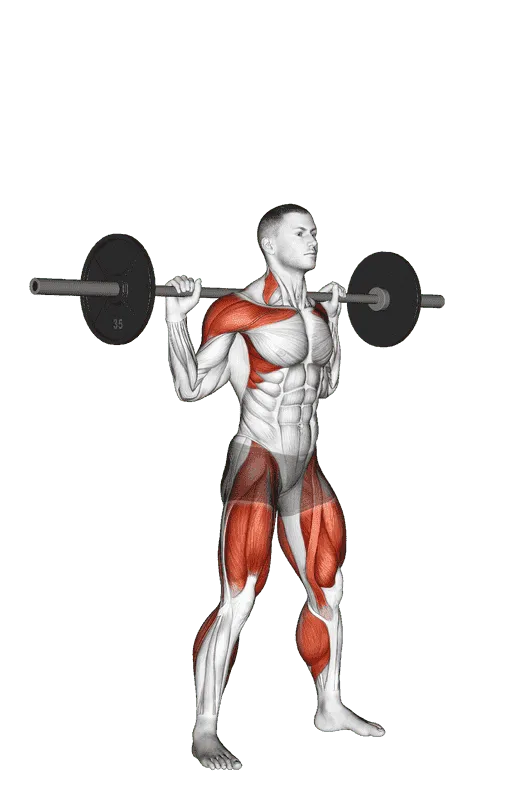
Questions about Barbell Heaving Snatch Balance
What muscles does the Barbell Heaving Snatch Balance work?
The Barbell Heaving Snatch Balance primarily targets the shoulders and upper legs, especially the quadriceps. It also engages the core, glutes, upper and lower back, triceps, and calves for stability and control during the lift.
What equipment do I need for the Barbell Heaving Snatch Balance?
You’ll need a barbell for this exercise, ideally with bumper plates if you’re training in a CrossFit or Olympic lifting environment. If you don’t have a barbell, there are limited alternatives—lightweight practice with a PVC pipe or dowel rod can help you learn the movement before progressing to heavier loads.
Is the Barbell Heaving Snatch Balance suitable for beginners?
This exercise is advanced and typically better suited for athletes with prior experience in overhead movements and squats. Beginners should first master basic overhead squats and push presses before attempting the snatch balance to ensure proper form and shoulder stability.
What are common mistakes to avoid when doing the Barbell Heaving Snatch Balance?
Common mistakes include not using a wide enough grip, losing core engagement, failing to squat deep enough, and pressing the bar instead of driving explosively under it. To avoid these, focus on proper grip width, maintain a braced core, and practice the timing of the dip and drop movement.
How many sets and reps should I do for the Barbell Heaving Snatch Balance?
For strength and technique, aim for 3–5 sets of 2–4 reps using moderate to heavy weight. Prioritize quality execution over volume, as fatigue can quickly lead to form breakdown in this complex lift.
What safety considerations should I keep in mind for the Barbell Heaving Snatch Balance?
Always warm up thoroughly, use proper lifting footwear, and perform the exercise in a clear, open space. Ensure you have adequate shoulder mobility and core strength, and use safety drops or platforms when training with heavier weights.
Are there variations or modifications for the Barbell Heaving Snatch Balance?
Yes, you can modify the movement by starting with lighter weights or practicing with a PVC pipe to refine technique. Variations include the standard snatch balance, the drop snatch, or performing the movement from pins in a power rack to focus on the catch position.