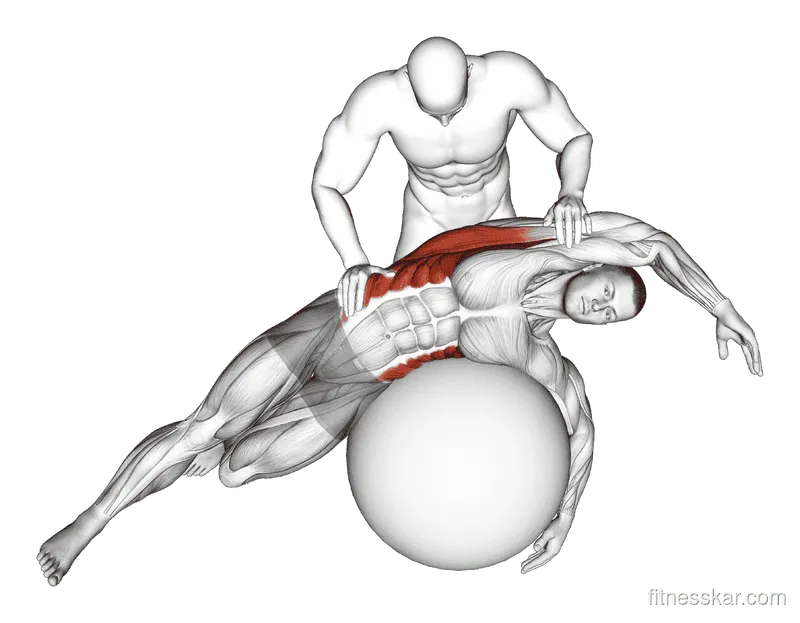
Assisted Oblique and Latissimus Dorsi Stretch on Stability Ball
Sit on a stability ball and walk your feet forward until your lower back is supported, then rotate so your side torso rests on the ball. Extend your top arm overhead and let your body curve laterally, feeling a stretch along your obliques and upper back. Have a partner gently press your shoulder and hip to deepen the stretch, keeping your core engaged and breathing deeply.
- Target muscles
- Obliques, Upper back
- Also works
- Abs, Lower back
- Equipment
- Exercise ball, Bodyweight
- Training style
- Mobility and recovery, Yoga and Pilates
- Logged as
- Seconds
- Popularity
- 75 of 100
Assisted Oblique and Latissimus Dorsi Stretch on Stability Ball: how to do it
- Begin by sitting on a stability ball and slowly walk your feet forward until your lower back is supported by the ball.
- Position your body sideways on the ball, ensuring your side torso is resting comfortably on the ball's surface.
- Extend your top arm overhead and allow your body to stretch laterally, creating a curve along your side.
- Have a partner assist by gently pressing on your shoulder and hip to deepen the stretch.
- Hold the stretch for 20-30 seconds, breathing deeply to relax into the position.
- Slowly return to the starting position and repeat on the opposite side.
Sets and reps (general guidance)
| Goal | Sets | Reps | Load |
|---|---|---|---|
| Strength | 3 to 5 | 3 to 6 | Heavy, full rest |
| Muscle and endurance | 3 to 4 | 8 to 12 | Moderate, perfect form |
Common mistakes
Avoid collapsing your core or overextending the spine, as this can put unnecessary pressure on the lower back. Maintain controlled movements and ensure your shoulder and hip remain aligned for an effective and safe stretch.
Alternatives
More Obliques exercises

Questions about Assisted Oblique and Latissimus Dorsi Stretch on Stability Ball
Which muscles does the Assisted Oblique and Latissimus Dorsi Stretch on a stability ball target?
This stretch primarily targets the obliques and upper back muscles, especially the latissimus dorsi. It also engages the abs and lower back for support and stability during the movement.
Do I need a stability ball for this stretch or can I use other equipment?
A stability ball is ideal for this exercise because it supports the spine and allows for greater lateral curvature. If you don’t have one, a firm yoga bolster or exercise bench with a padded surface can be used, though it may reduce the range of motion.
Is the Assisted Oblique and Lat Stretch suitable for beginners?
Yes, beginners can perform this stretch, especially with an experienced partner to guide them. Start with a gentle range of motion and focus on breathing and posture to avoid strain.
What are common mistakes to avoid when performing this stability ball stretch?
Avoid collapsing your core or overextending the spine, as this can put unnecessary pressure on the lower back. Maintain controlled movements and ensure your shoulder and hip remain aligned for an effective and safe stretch.
How long should I hold the Assisted Oblique and Lat Stretch?
Hold the stretch for 20–40 seconds on each side, focusing on deep breathing and muscle relaxation. Repeat the stretch 2–3 times per side for best mobility benefits.
What safety tips should I follow when doing this stretch with a partner?
Communicate clearly with your partner about comfort levels and avoid sudden or forceful adjustments. Ensure the ball is stable and your feet are firmly planted to prevent slipping.
Are there variations or modifications for the Assisted Oblique and Lat Stretch?
You can perform a solo version without a partner by using your own arm weight for the stretch. For a deeper stretch, try holding a light dumbbell overhead, but only if your flexibility and core strength are sufficient.