If your goal is to build an impressive, athletic physique that commands respect from every angle, developing wide, dense latissimus dorsi muscles is non-negotiable. The lats are the primary anatomical engine responsible for the iconic "V-taper"—creating the optical illusion of a narrow waist, broad shoulders, and powerful athletic proportions. Yet, for millions of dedicated lifters who grind through countless sets of pull-ups, pulldowns, and barbell rows each week, back width remains frustratingly elusive. Most gym-goers feel their back workouts predominantly in their forearms, biceps, and upper trapezius, leaving their lower and mid-lat fibers virtually untouched.
Building wide lats is not a matter of sheer genetic luck or mindlessly piling heavy plates onto a barbell. It is a precise biomechanical puzzle governed by the line of pull, shoulder joint angles, elbow trajectories, and active muscular tension across the entire range of motion. When you understand how the different divisions of the latissimus dorsi run and how to align your resistance curve with individual joint mechanics, back training ceases to be guesswork.
This comprehensive masterclass dissects the functional anatomy, biomechanical principles, and science-backed training protocols required to achieve maximum lat hypertrophy. Whether you are struggling with a stubborn mind-muscle connection or looking to optimize an advanced bodybuilding split, this guide provides the exact roadmap to build a broader, thicker back.
Functional Anatomy: Decoding the Latissimus Dorsi
To stimulate meaningful muscle growth, you must understand the anatomical architecture of the muscle you are training. The latissimus dorsi is the broadest and most superficial muscle of the human posterior kinetic chain, extending across almost the entire lower and middle back.

The Three Anatomical Divisions
Contrary to the outdated belief that the lat is a single monolithic sheet of tissue, modern anatomical and electromyographical investigations demonstrate that the latissimus dorsi is divided into three distinct functional regions based on their skeletal origin and fiber orientation:
- Thoracic Division: Originates from the spinous processes of thoracic vertebrae T7 through T12. The fibers of this upper compartment run in a relatively horizontal and diagonal trajectory toward the armpit. They assist primarily in horizontal pulling and scapular retraction.
- Lumbar Division: Originates from the thoracolumbar fascia spanning the lumbar vertebrae (L1–L5) and the posterior sacrum. These middle fibers angle diagonally upward, contributing substantially to shoulder extension.
- Iliac Division (The Lower Lats): Originates from the posterior third of the iliac crest (the crest of your hip bone). The iliac fibers run almost vertically upward along the lateral border of the torso. These are the fibers responsible for that sought-after "sweep" that extends all the way down to the waistline.
All three divisions converge and twist 180 degrees before inserting into the intertubercular groove (bicipital groove) of the humerus (upper arm bone). Because of this unique spiral insertion, the lats not only extend and adduct the arm, but also act as internal rotators of the shoulder joint.
Primary Joint Actions
The lats execute three primary biomechanical movements at the glenohumeral (shoulder) joint:
- Shoulder Extension: Pulling the upper arm down and back from an elevated frontal position (sagittal plane). This is the dominant action during seated cable rows and straight-arm pulldowns.
- Shoulder Adduction: Pulling the upper arm down from an outward, overhead position toward the side of the torso (frontal plane). This is the dominant action during traditional wide-grip pulldowns.
- Scapular Depression: Actively pulling the shoulder blades downward toward the pelvis. Without active scapular depression, the upper trapezius and levator scapulae dominate the initial phase of any pulling exercise.
Understanding these mechanics reveals the core secret of lower lat isolation: because the iliac fibers run vertically toward the hip, they are best loaded through sagittal-plane shoulder extension with the arm kept close to the body, rather than ultra-wide flaring in the frontal plane.
The Biomechanics of Back Width vs. Thickness
In bodybuilding lore, a persistent myth claims that "pulldowns build back width, while rows build back thickness." Biomechanically, this statement is false. Both vertical pulls and horizontal rows can build exceptional lat width—or exceptional upper back thickness—depending entirely on two crucial variables: elbow trajectory and grip orientation.
The Elbow Path Rule
The direction in which your humerus moves relative to your ribcage determines which muscle fibers experience the highest mechanical tension:
- Elbows Tucked (0° to 30° Flaring): When you pull with your elbows tracking tightly alongside your ribs, the line of pull perfectly matches the fiber orientation of the latissimus dorsi. The lats have maximum mechanical leverage, while the upper back musculature is placed at a mechanical disadvantage.
- Elbows Flared (60° to 90° Flaring): When your elbows flare out wide away from your torso, the line of pull shifts upward. This angle places the rhomboids, middle and lower trapezius, rear deltoids, and teres major in the primary line of force. The lats can only contribute as secondary stabilizers.
If your goal on a given exercise is pure lat hypertrophy, your elbows must remain tucked close to your torso. If your goal is mid-back and rhomboid development, flare your elbows outward and pull toward your lower sternum. For a detailed breakdown of upper back vs. lower back training, consult our comprehensive guide on the best back exercises.
The Range of Motion Paradox: When to Stop the Pull
One of the most frequent execution errors in gym culture is pulling the elbow too far back during rowing movements. Lifters often believe that squeezing their shoulder blades together as hard as possible at the finish creates greater lat growth.
However, the functional moment arm of the latissimus dorsi ends once your elbow reaches the plane of your torso (your hip). When you yank your elbow past your ribcage into hyperextension:
- The latissimus dorsi becomes actively insufficient (fully shortened) and cannot generate meaningful tension.
- The humeral head glides forward (anterior femoral/humeral glide), placing shear stress on the anterior shoulder capsule.
- The workload shifts entirely onto the posterior deltoid, triceps long head, and upper scapular retractors.
To maximize lat tension, stop your rowing stroke the instant your elbow aligns with your hip. Hold that peak isometric contraction for a full second before reversing into a controlled eccentric stretch.
Debunking the Wide-Grip Pulldown Myth
For decades, bodybuilders preached that "to get a wide back, you must use a wide grip." Lifters would grab the outermost bends of a long lat pulldown bar, believing that this exaggerated width transferred directly into broader wings.
Exercise science has definitively proven this theory wrong. In a landmark electromyographic study conducted by Andersen and colleagues, researchers measured muscle activity in the latissimus dorsi, biceps brachii, and trapezius across different grip widths (narrow, medium, and wide) and forearm orientations (pronated and supinated) during the lat pulldown.[1]
The findings were striking: the medium, shoulder-width grip produced equal or greater latissimus dorsi activation compared to the wide grip, while significantly outperforming the wide grip in total load capacity and mechanical work.[1] Furthermore, the wide grip significantly shortened the active range of motion at both the shoulder and elbow joints.[1]
The Stretch-Mediated Hypertrophy Advantage in Back Training
Recent exercise physiology research has highlighted the critical role of stretch-mediated hypertrophy—the accelerated muscle growth that occurs when a muscle is subjected to high mechanical tension at long muscle lengths, especially when paired with progressive overload and systematic training close to failure.
The latissimus dorsi is uniquely suited to capitalize on this phenomenon. Because the lats originate along the spine and pelvis and insert onto the humerus, raising your arms fully overhead with slight forward torso flexion places the lat fibers in a position of maximum passive tension.

When you allow the weight to pull your shoulders up and forward into full scapular elevation and upward rotation at the top of a pulldown or row, titin filaments within the muscle sarcomeres produce passive elastic tension. Contracting forcefully from this elongated state sends a potent anabolic signal for sarcomerogenesis (adding sarcomeres in series), resulting in rapid structural hypertrophy.
To harness this mechanism:
- Never cut the top half of your pulldowns or pull-ups short.
- At the top of every rep, allow your shoulder blades to elevate freely toward your ears under control.
- Pause for a distinct half-second in the fully stretched position before initiating the concentric drive.
Top 4 Hypertrophy Movements for Wide Lats
Rather than performing a dozen redundant exercises in a single session, build your back routine around these four scientifically validated staples that target every division of the latissimus dorsi.
1. Neutral-Grip Lat Pulldown
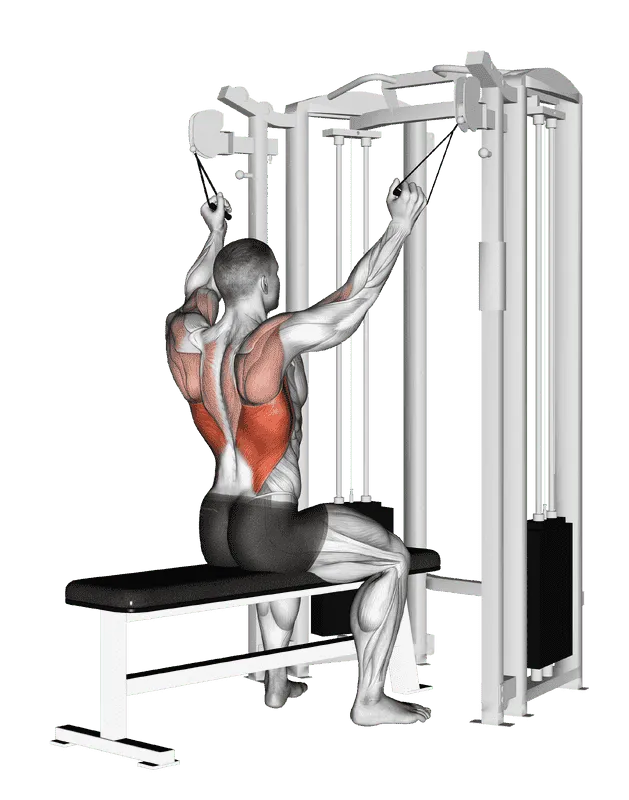
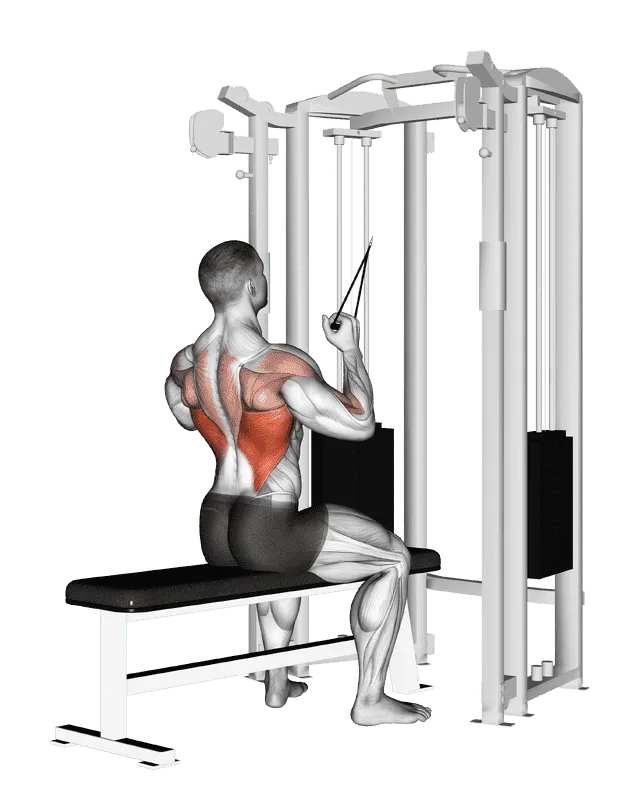
The neutral-grip pulldown is the premier vertical pulling exercise for isolating the latissimus dorsi. By utilizing two parallel handles spaced roughly shoulder-width apart, your hands remain semi-supinated, allowing your elbows to track naturally in the sagittal and scapular planes.
- Sets
- 3–4
- Reps
- 8–12
- Rest
- 120 s
- Tempo
- 3–0–1–1
- Setup & Execution: Sit tall in the lat pulldown machine with your thighs firmly secured beneath the rollers. Grasp a parallel-grip V-bar or twin neutral handles. Lean your torso back roughly 10 to 15 degrees.
- The Cue: "Do not pull with your hands. Think of your hands as passive hooks. Drive your elbows straight down toward your hip pockets."
- Contraction: Bring the attachment down to the level of your upper chest, hold the peak contraction for one second while actively flexing your lats, then control the ascent over three full seconds until your arms and scapulae are fully elevated overhead.
Lifters who do not have access to dual neutral handles can perform standard Lat Pulldown with a medium overhand grip, focusing on identical elbow tracking.
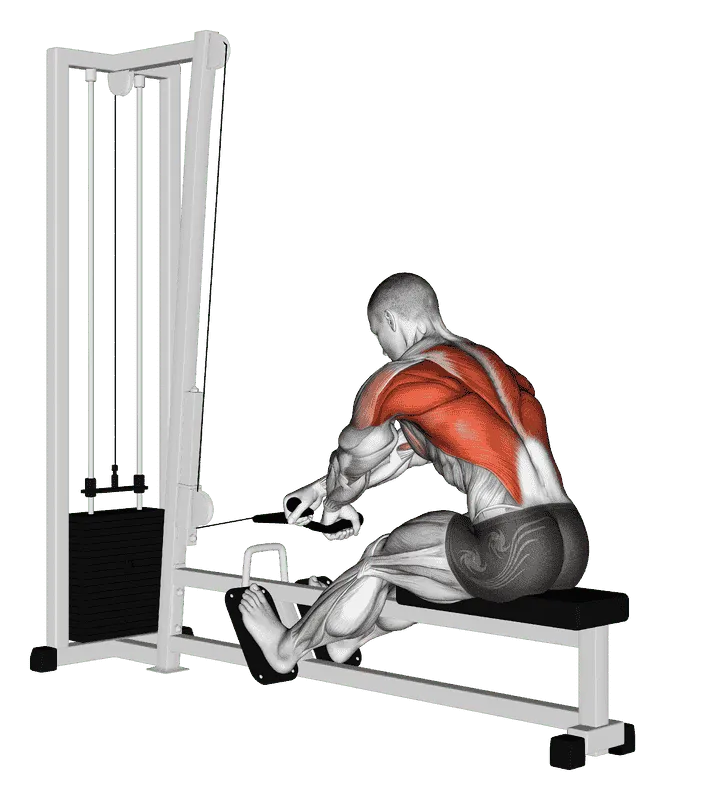
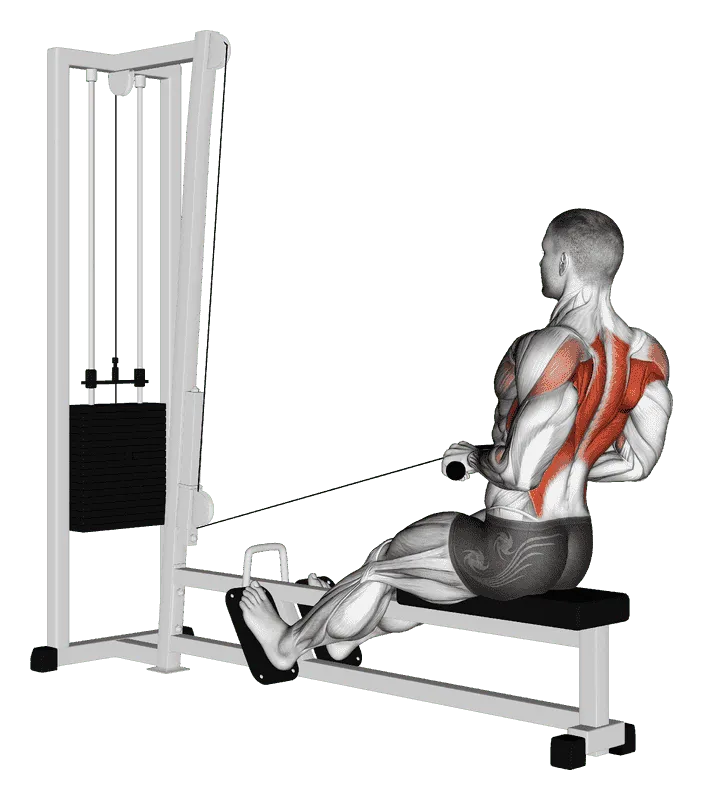
2. Chest-Supported Neutral-Grip Lat Row / Seated Cable Row
The chest-supported row is the single most effective horizontal movement for building lower and mid-lat thickness. By supporting your sternum against an incline bench or machine pad, you completely remove lower back fatigue and spinal erector stabilization from the equation, allowing 100% of your neural output to focus on the target fibers.
- Sets
- 3
- Reps
- 8–10
- Rest
- 120 s
- Tempo
- 2–1–1–1
- Setup & Execution: Position yourself on a seated cable row machine or an adjustable incline bench set to 30–45 degrees using dumbbells (Dumbbell Bent-Over Row). Attach a close-grip neutral handle to the low pulley.
- The Cue: "Lead with the elbows. Slide your arms along your ribcage as if scraping paint off your sides."
- Range of Motion: Pull until your upper arms are parallel with your torso. Avoid arching your lower back or yanking your elbows behind your spine. Squeeze your lats fiercely at the peak, then take two seconds to return to the stretched position, allowing your lats to stretch forward without letting your chest leave the pad.
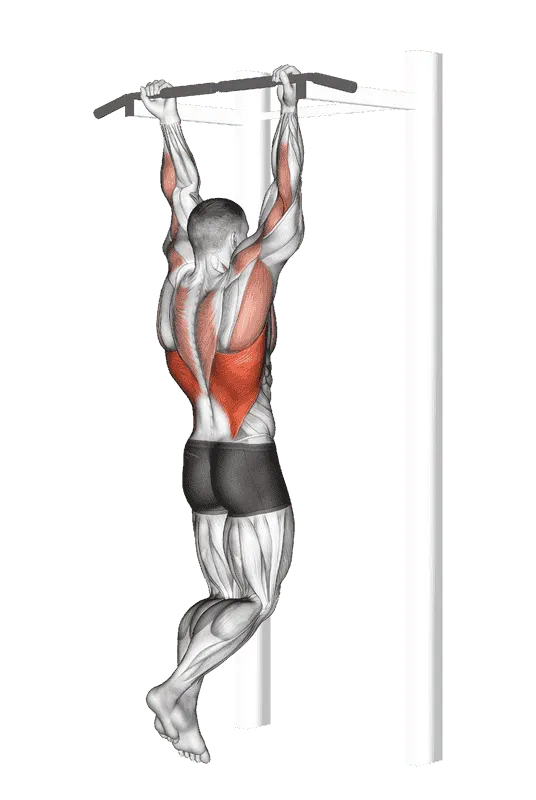
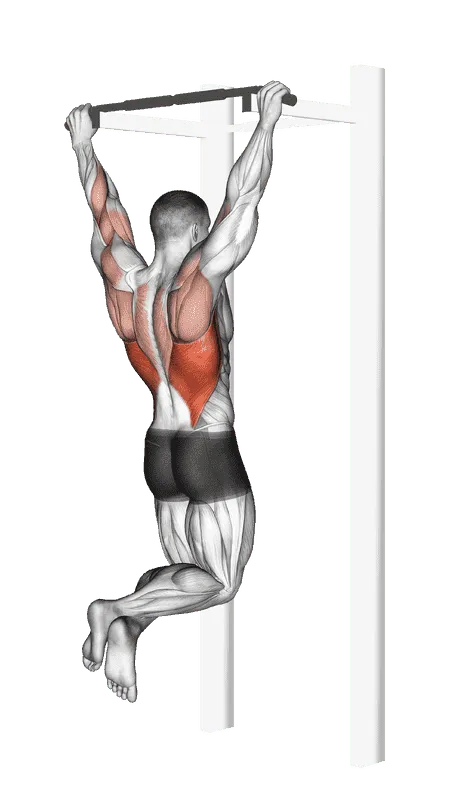
3. The Weighted Pull-Up / Bodyweight Pull-Up
While cable machines provide customized resistance curves, the closed-kinetic-chain nature of the Pull-Up recruits the highest threshold motor units in the upper body. Pulling your own bodyweight through space requires intense core bracing, scapular control, and full-body irradiation.

- Sets
- 3–4
- Reps
- 6–8
- Rest
- 150 s
- Tempo
- 2–1–1–1
- Setup & Execution: Take an overhand grip just outside shoulder width. Hang in a full stretch (dead hang) with your legs straight or crossed behind you.
- The Cue: "Pull the bar down to your collarbones while pulling your chest through the window of your arms."
- Progressive Overload: Once you can complete three clean sets of 8 strict bodyweight reps with a full dead hang at the bottom, introduce a dip belt with micro-loading (1.25 to 2.5 kg). Alternatively, lifters experiencing shoulder discomfort can switch to the Chin-Up, which provides greater biceps assistance while still delivering tremendous lat recruitment.
4. Cable Straight-Arm Pulldown
Every compound pulling exercise involves the biceps brachii and brachialis as secondary movers. If your arms consistently fatigue before your back, the cable straight-arm pulldown is your ultimate isolation weapon. Because the elbow joint remains fixed in a slight bend throughout the movement, the biceps cannot contribute, isolating the latissimus dorsi through pure shoulder extension.


- Sets
- 3
- Reps
- 12–15
- Rest
- 90 s
- Tempo
- 2–0–1–1
- Setup & Execution: Stand facing a high pulley with a straight bar or rope attachment. Step back two feet and hinge forward at the hips roughly 30 degrees, keeping your chest proud and spine neutral.
- The Cue: "Push the bar away from the machine in a giant arc, driving the bar down to your upper thighs."
- Contraction: Squeeze your lats aggressively at the bottom, hold for one full second, then allow the cable to pull your arms back up above eye level for a deep, ribcage-expanding stretch.
Complete Weekly Programming & Volume Landmarks
Optimal lat development requires adhering to the core tenets of progressive overload and periodization. You cannot maximize hypertrophy by blasting your back with 25 random sets once a week on an old-school "back day" and leaving it dormant for six days.
Volume Landmarks for Lat Hypertrophy
According to comprehensive sports science research, skeletal muscle responds best to specific volume thresholds:
- Minimum Effective Volume (MEV): Roughly 8 to 10 hard sets per week. This is the minimum dose required to trigger measurable lat growth in trained individuals.
- Maximum Adaptive Volume (MAV): Between 12 and 18 hard sets per week. This is the hypertrophic "sweet spot" where the majority of lifters make their fastest gains.
- Maximum Recoverable Volume (MRV): Approximately 20 to 22 hard sets per week. Beyond this ceiling, additional volume produces systemic fatigue that exceeds recovery capacity, leading to stalled progress and joint inflammation.
For an exhaustive breakdown of individual volume titration, read our guide on how many sets per muscle per week deliver the best results.
Training Frequency: The 2x per Week Advantage
Splitting your weekly volume across two distinct sessions per week is vastly superior to a once-weekly marathon workout. Muscle Protein Synthesis (MPS) in response to a hard resistance training session remains elevated for 24 to 48 hours before returning to baseline. By training your lats twice per week (for example, on an Upper/Lower or Push/Pull/Legs split), you trigger the anabolic MPS machinery twice in the same 7-day period.
Furthermore, dividing 14 weekly sets into two sessions of 7 sets ensures that every single rep is performed with maximum neural drive, bar speed, and mechanical tension, rather than degraded junk volume.
8-Week Lat Hypertrophy Periodization Routine
Integrate this evidence-based split into your weekly programming, leaving at least 72 hours of recovery between Back Session A and Back Session B.
| Session | Exercise | Sets | Reps | Tempo | Rest | Target Focus |
|---|---|---|---|---|---|---|
| Session A (Vertical Bias) | Weighted Pull-Up | 3 | 6–8 | 2-1-1-1 | 150 s | High mechanical tension, upper/mid lats |
| Neutral-Grip Lat Pulldown | 3 | 8–10 | 3-0-1-1 | 120 s | Stretch emphasis, iliac lat fibers | |
| Dumbbell Incline Row | 3 | 10–12 | 2-1-1-1 | 90 s | Stable mid-back and thoracic lat support | |
| Cable Straight-Arm Pulldown | 3 | 12–15 | 2-0-1-1 | 90 s | Pure lat isolation and metabolic pump | |
| Session B (Horizontal Bias) | Chest-Supported Lat Row | 4 | 8–10 | 2-1-1-1 | 120 s | Sagittal extension, lower lat fibers |
| Lat Pulldown (Supinated Grip) | 3 | 10–12 | 3-0-1-1 | 90 s | Biceps synergy and long-length stretch | |
| Dumbbell Bent-Over Row | 3 | 8–10 | 2-0-1-1 | 120 s | Unilateral stabilization and raw overload |
To structure this template within a comprehensive multi-week phase, check out our structured 3‑Week Back Builder in the Fitnesskar app:
Lifters seeking a broader physique overhaul can combine this with our Back, Shoulders & Traps Mass Builder to develop the complete upper-body V-taper.
The Mind-Muscle Connection: Neurological Secrets for Lat Activation
The latissimus dorsi is notoriously difficult for beginner and intermediate lifters to recruit because it resides outside your field of direct vision. When you bench press or curl, you can watch the muscle contract. With back training, you must rely entirely on internal proprioceptive feedback.
Apply these three neurological strategies to immediately amplify lat engagement:
1. The Hook Grip with Lifting Straps
Your grip is the neurological bottleneck of back training. The moment your forearms and finger flexors struggle to hold a heavy bar or dumbbell, your brain activates neural inhibition, blunting motor unit firing in the larger prime movers (your lats) to protect smaller wrist tendons from trauma.
Using high-quality lifting straps or figure-8 straps eliminates grip strength as a limiting factor. By removing finger fatigue, straps allow you to adopt a thumbless "false grip" (hooking your four fingers over the bar) and direct 100% of your neural intent into driving your elbows backward.
2. Scapular Depression Pre-Set
Before initiating any row or pulldown, perform a distinct scapular pre-set. Without bending your elbows, deliberately pull your shoulder blades down away from your ears. This pre-engages the lower trapezius and latissimus dorsi, anchoring your scapulae so that the subsequent pull travels directly through the target muscle rather than being hijacked by the upper traps.
3. Lateral Trunk Tilting for Lower Lat Fibers
Because the iliac fibers attach directly to the iliac crest, you can heighten active tension by introducing a subtle lateral trunk crunch during single-arm cable pulldowns or single-arm rows. As you drive your elbow down toward your hip, allow your torso to laterally flex slightly toward the working side. This shortens the distance between origin and insertion, producing an intense, cramp-like contraction in the lower lats that bilateral movements cannot match.
Common Form Mistakes and How to Avoid Them
Avoid these four common training traps to keep your joints healthy and your lats growing:
- Jerking with Lower Back Momentum: Rocking backward 45 degrees during a lat pulldown turns the movement into a sloppy, momentum-driven row. Anchor your thighs and keep torso angle variations within a strict 10-degree window.
- Shortchanging the Eccentric Phase: Letting the weights crash back to the stack robs you of the most anabolic portion of the repetition. Take two to three full seconds to lower the weight, feeling the lats open up and stretch under control.
- Leading with the Hands Instead of Elbows: If you think about pulling with your hands, your nervous system automatically recruits the biceps brachii. Visualize your hands merely as chains connecting the load directly to your elbow joints.
- Neglecting Unilateral Work: Symmetrical bars can mask strength imbalances between your dominant and non-dominant sides. Ensure at least one third of your weekly back volume consists of single-arm cable or dumbbell variations.
Frequently Asked Questions
Frequently asked questions
Can I build wide lats without doing pull-ups?
Absolutely. While pull-ups are a phenomenal bodyweight exercise, lat pulldowns with neutral or shoulder-width handles replicate the exact same glenohumeral mechanics while allowing precise micro-loading and eliminating bodyweight fatigue. Cables and chest-supported rows provide equal or superior hypertrophy stimuli.
How long does it take to see visible lat width?
With consistent progressive overload and a dedicated caloric surplus or maintenance diet, noticeable lat development typically appears within 8 to 12 weeks. Lifters with poor initial mind-muscle connection often see rapid improvements within the first 4 weeks simply from mastering elbow path and scapular depression.
Should I train lats on a separate day or with chest?
Both setups work exceptionally well. A Push/Pull/Legs split pairs lats with biceps and rear delts on Pull day, allowing concentrated volume. Alternatively, an Arnold-style Chest/Back antagonist split allows you to alternate pressing and pulling sets, enhancing blood flow and workout density.
Why do I only feel my lats in the upper portion and not the lower sweep?
The lower iliac fibers require sagittal-plane shoulder extension with the arm kept tight against the ribcage. If you exclusively perform wide-grip pulldowns with flared elbows, you are targeting your teres major and upper lats. Switch to neutral-grip single-arm cable pulldowns and tight-elbow rows to stimulate the lower sweep.
Sources
- Andersen V, Fimland MS, Wiik E, et al. Effects of grip width and grip orientation on muscle activity in the lat pulldown. Journal of Strength and Conditioning Research. 2014. doi.org/10.1519/JSC.0000000000000232 ↩