Your one-rep max (1RM) is the heaviest weight you can lift once, with good technique, in a given exercise. It's the standard measure of maximal strength and the number most strength programs use to set training loads.
You don't have to test it to use it. For most people, a good estimate from a hard set of a few reps is enough. This guide explains how to estimate your 1RM, when a real test is worth it, how to run one safely, and how to turn the number into training weights.
One-rep max calculator
(Epley , Brzycki )
| % of 1RM | Load |
|---|---|
Estimates are most accurate between 2 and 10 reps. Test a true 1RM only with a spotter and a proper warm-up.
What a one-rep max is, and isn't
A 1RM is specific to one exercise and one technique standard. A paused bench press and a touch-and-go bench press have different maxes, and so does a squat to parallel versus a squat above it. It also moves from day to day with sleep, stress and fatigue, so think of it as a snapshot rather than a fixed trait.
Tested properly, though, it's a trustworthy number. A systematic review of 32 studies with 1,595 participants found good to excellent test-retest reliability for the 1RM test (a median intraclass correlation of 0.97 and a median coefficient of variation of 4.2%), whether or not people had lifting experience or familiarization sessions, and for upper- and lower-body exercises alike.[1]
Estimating your 1RM from a set of reps
The two most widely used formulas are:
- Epley: 1RM = weight × (1 + reps ÷ 30)
- Brzycki: 1RM = weight × 36 ÷ (37 − reps)
For example, if you squat 100 kg for 5 reps, Epley estimates a 1RM of about 116.7 kg and Brzycki about 112.5 kg. The two give identical results at 10 reps (133.3 kg from 100 kg × 10); below 10 reps, Epley's estimate is slightly higher. The calculator above does the math for you.
Put another way, each formula assumes a certain percentage of your 1RM for each number of reps you can complete:
| Reps to failure | Epley | Brzycki |
|---|---|---|
| 2 | 94% | 97% |
| 3 | 91% | 94% |
| 4 | 88% | 92% |
| 5 | 86% | 89% |
| 6 | 83% | 86% |
| 8 | 79% | 81% |
| 10 | 75% | 75% |
| 12 | 71% | 69% |
The limits of the formulas
- Fewer reps give better estimates. When 70 people were tested for 1-, 5-, 10- and 20-rep maxes on the barbell bench press and leg press, their 5RM predicted their 1RM most accurately, and the authors advised against using more than 10 reps with simple linear equations.[2] In a study of 103 women, prediction equations were also more accurate when fewer than 10 reps to fatigue were used, both before and after 12 weeks of training.[3]
- People and exercises differ. A meta-regression of 952 rep tests from 269 studies (7,289 people) found that the number of reps you can do at a given percentage of your 1RM differs from person to person, and that more reps were possible in the leg press than in the bench press across the whole loading range. Sex, age and training status had little influence.[4] One formula can't be equally accurate for every lift.
In practice: use a set of 3 to 6 reps that ends with no more than one rep left in the tank, use the same technique you would for a single, and treat the result as an estimate. Re-estimate every few weeks as you get stronger.
Should you test a true 1RM?
Testing a real single makes sense if you compete in powerlifting, if you're an intermediate or advanced lifter who wants a precise number at the end of a training block, or if you simply enjoy it. It isn't necessary for building strength.
Skip the max and estimate instead if you're in your first few months of lifting, if your technique still changes from session to session, or if you're coming back from an injury. Near-maximal attempts also come with a brief breath-hold (the Valsalva maneuver) that is practically unavoidable with loads above roughly 80% of your maximum and raises your blood pressure during the effort.[5]
How to test your 1RM safely
Before the test: test one lift per session, when you're fresh (ideally after a lighter week), with a spotter or safety pins in place, and decide beforehand what counts as a valid rep, such as depth in the squat or a pause on the chest.
- General warm-up: 5 to 10 minutes of easy cardio and a few mobility drills.
- Warm-up sets (percentages of your estimated 1RM): 8 to 10 reps with the empty bar or about 40–50%, 5 reps at about 60%, 3 reps at about 70%, 2 reps at about 80% and 1 rep at about 90%.
- First attempt: about 95% of your estimate, a weight you are confident you can lift.
- Next attempts: if the rep moved well, add 2–5% (usually 2.5 to 5 kg) and try again. Rest 3 to 5 minutes between heavy singles.
- Stop when a rep slows dramatically, your technique breaks down, or you miss. Your 1RM is the heaviest clean rep. Aim to find it within three to five attempts.
Standardized protocols like this one are what make 1RM tests reliable. In one study that tested 1RMs on machines, participants warmed up on a bike, did 8 to 10 light reps at about 50% of their predicted max, then a set at about 80%, and added weight after each successful lift until they missed, reaching their 1RM within five attempts.[6]
The lifts people test most often
-
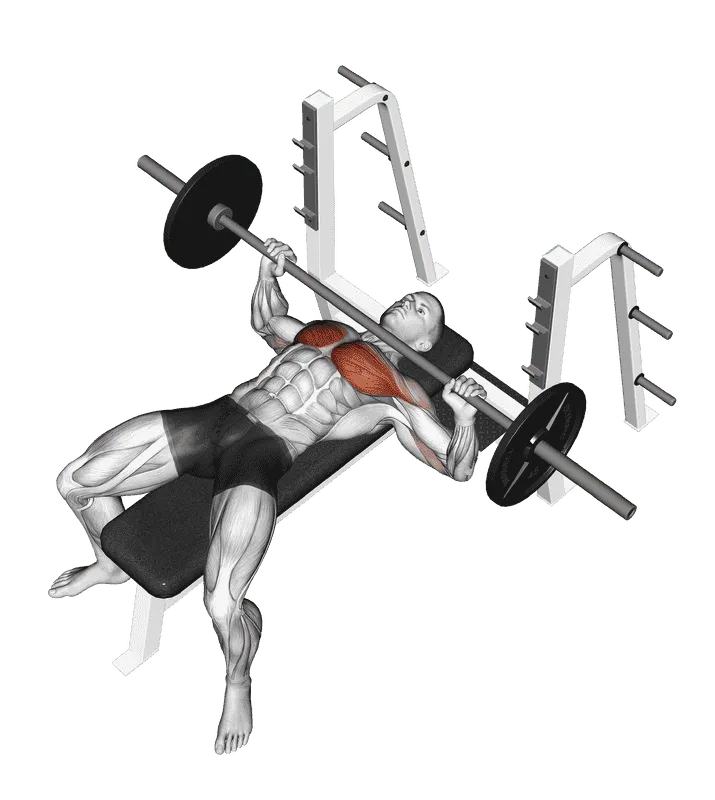
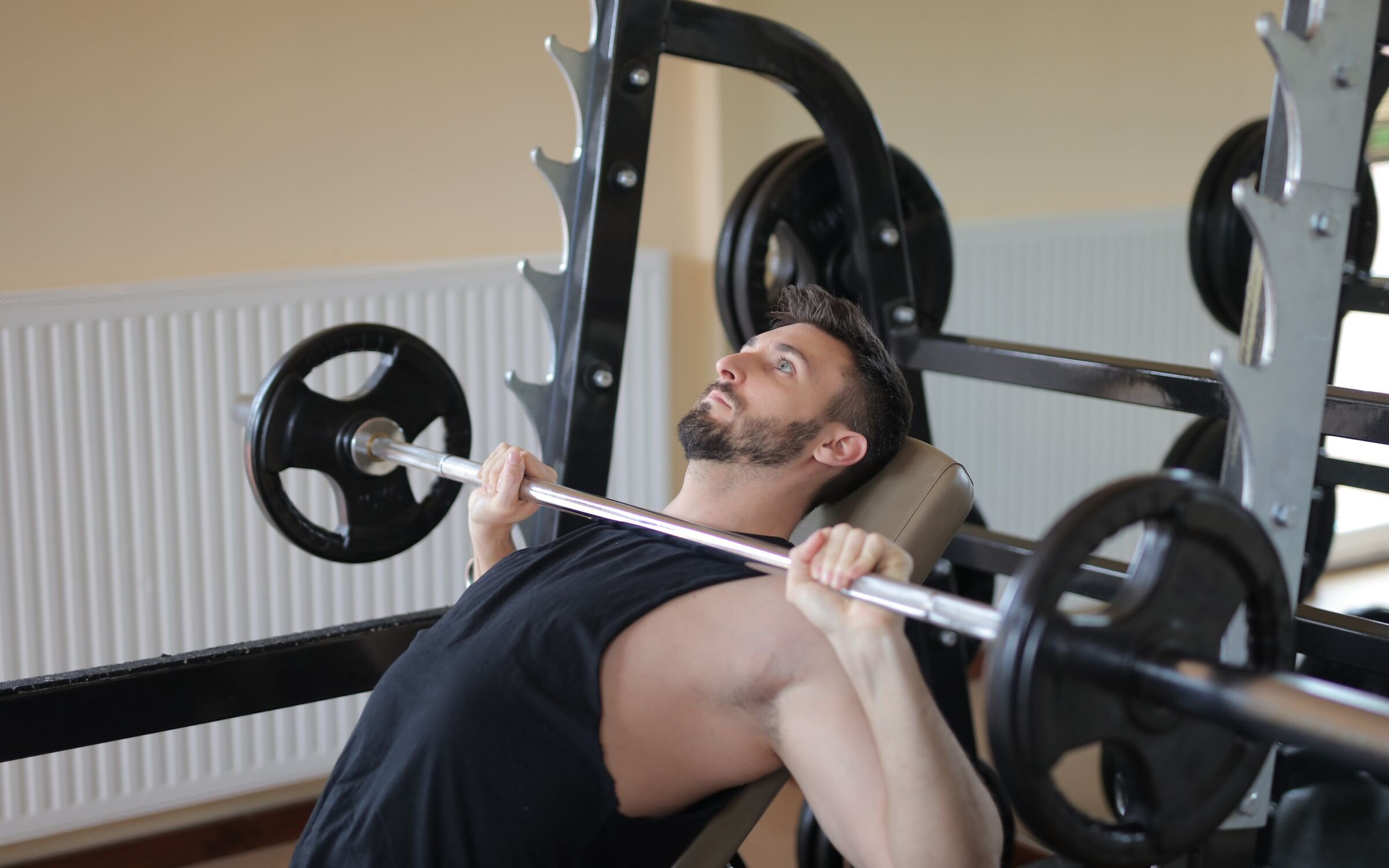
Barbell Bench Press Use a spotter for the lift-off and the catch, or safety arms set just below your chest. Keep your thumbs wrapped around the bar. -
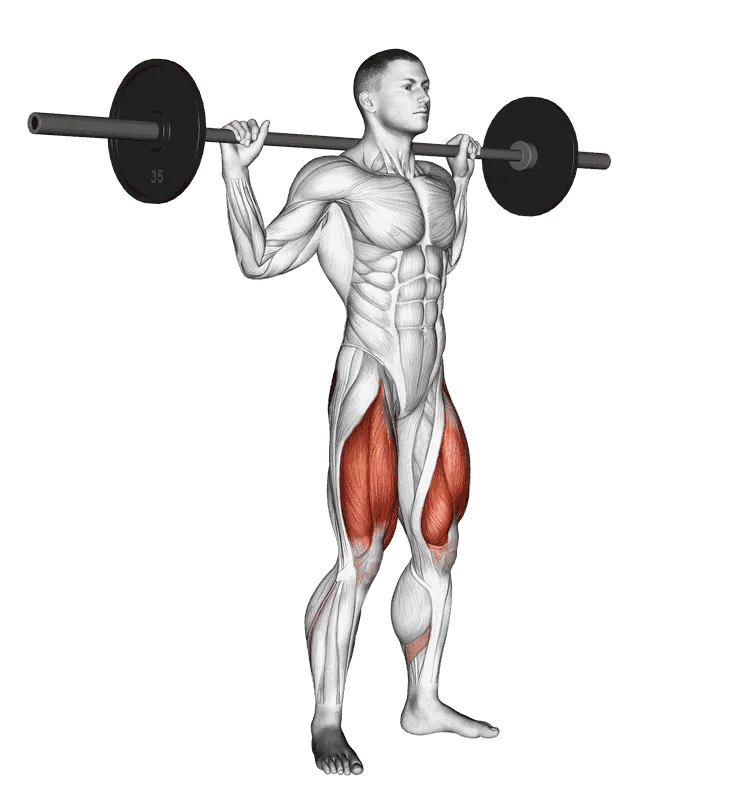
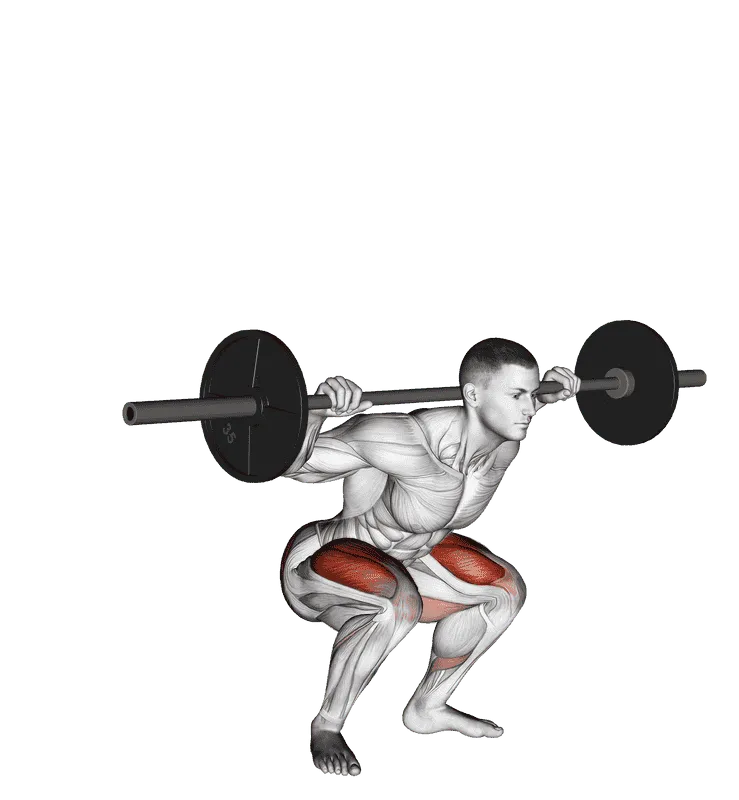
Barbell Full Squat Test inside a rack with the safety pins set just below your depth. Every attempt must reach the same depth you train to. -
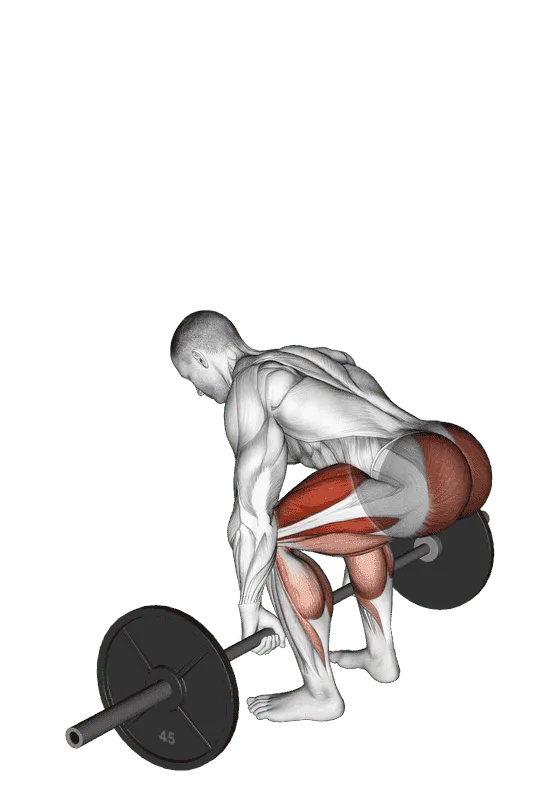
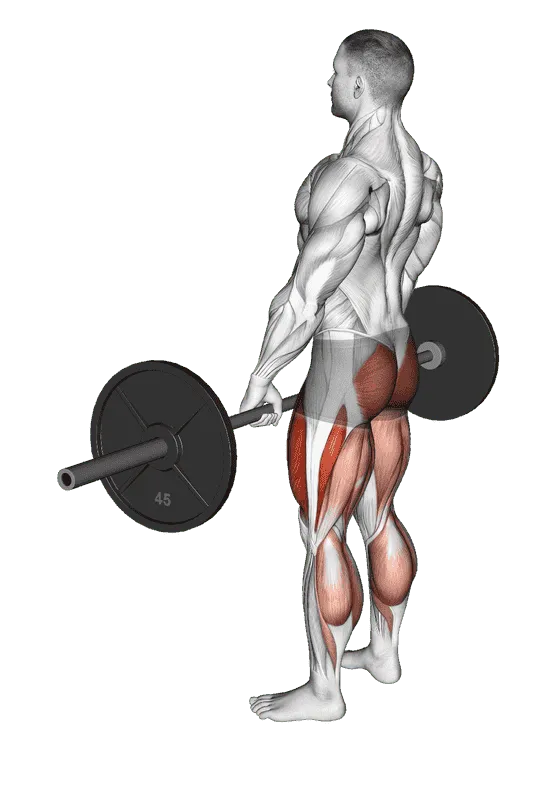
Barbell Deadlift No spotter needed, but end the attempt if your lower back rounds. Don't bounce the bar off the floor. -
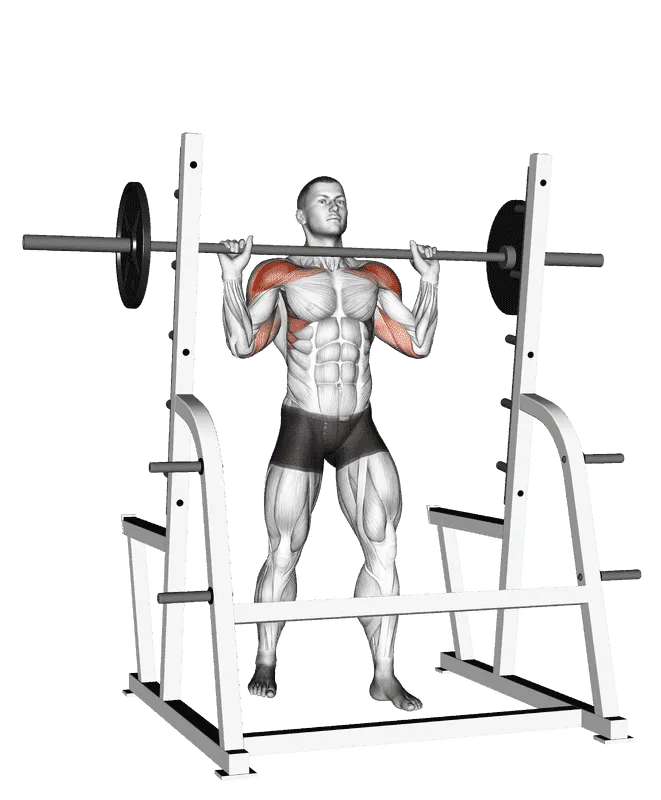
Barbell Standing Military Press Press from a rack, squeeze your glutes and don't lean back to finish the rep.
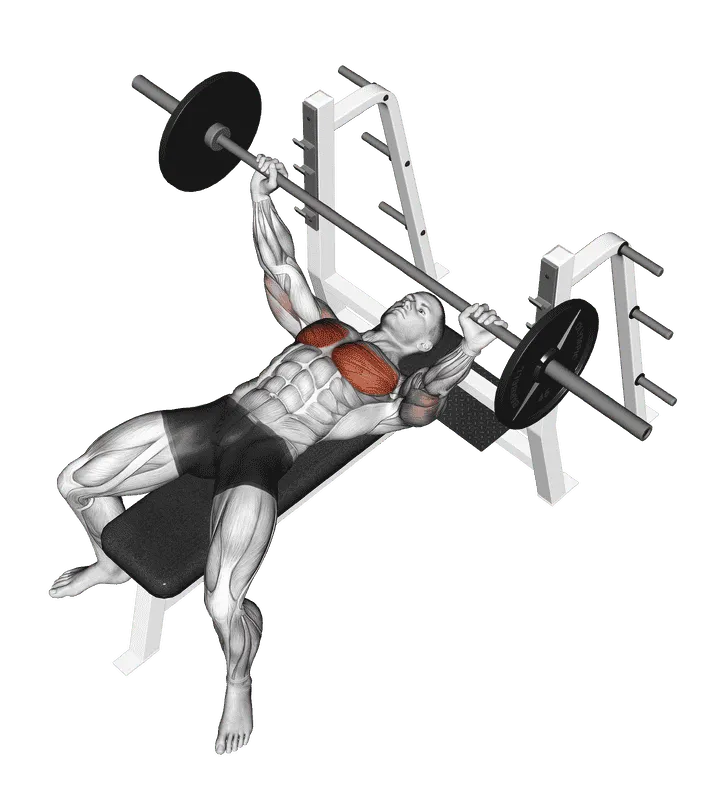

For technique on the most-tested lift, see how to bench press.
Training with percentages
Once you have a 1RM, estimated or tested, you can set training loads as percentages of it. The American College of Sports Medicine's position stand recommends loads in the 8 to 12 rep-max range for novices. For strength in experienced lifters, it recommends a periodized mix of 1 to 12 rep-max loads, with an eventual emphasis on heavy 1 to 6 rep-max loads and 3 to 5 minutes of rest; for muscle growth, an emphasis on 6 to 12 rep-max loads with 1 to 2 minutes of rest; and for muscular endurance, 40–60% of 1RM for more than 15 reps, with under 90 seconds of rest.[7]
| Goal | Reps per set | Approximate %1RM | Rest between sets |
|---|---|---|---|
| Maximal strength | 1–6 | 80–95% | 3–5 minutes |
| Muscle growth | 6–12 | 65–85% | 1–3 minutes |
| Muscular endurance | 15 or more | 40–60% | Under 90 seconds |
Here's how it works: if your estimated squat 1RM is 100 kg, five sets of five at 80% means 80 kg, and three sets of ten at 70% means 70 kg. Round to the nearest load you can make with your plates.
Muscle growth isn't limited to that middle row; lighter loads can build muscle too when sets are taken close to failure. Our guide to strength vs. hypertrophy training explains how to combine the zones.
If you're new to lifting, you don't need percentages yet: a simple plan that adds a little weight each session works better. Start with our beginner strength program.
Frequently asked questions
How often should I test my one-rep max?
For most people, no more than every 8 to 12 weeks, usually at the end of a training block after a lighter week. In between, re-estimate your max from your working sets.
Is 1RM testing safe for beginners?
The test itself is reliable even for people without lifting experience, but beginners gain little from maximal attempts while their technique is still settling. In your first months, estimate your max from a set of 3 to 6 reps and focus on technique.
Which formula is more accurate, Epley or Brzycki?
Neither wins across the board. They agree exactly at 10 reps and differ by only a few percent below that, with Epley giving slightly higher estimates. Using a low-rep set taken close to failure matters more than the formula you choose.
Why doesn't my estimated 1RM match what I can actually lift?
The reps you can do at a given percentage vary between people and exercises, and technique standards, fatigue and practice with heavy singles all affect the result. Treat the estimate as a starting point and adjust by how the bar moves.
Do women need a different formula?
Probably not. A large meta-regression found that sex, age and training status had little influence on how many reps people can do at a given percentage of their 1RM.
Sources
- Grgic J, Lazinica B, Schoenfeld BJ, Pedisic Z. Test-Retest Reliability of the One-Repetition Maximum (1RM) Strength Assessment: a Systematic Review. Sports Medicine - Open. 2020. pubmed.ncbi.nlm.nih.gov/32681399/ ↩
- Reynolds JM, Gordon TJ, Robergs RA. Prediction of one repetition maximum strength from multiple repetition maximum testing and anthropometry. Journal of Strength and Conditioning Research. 2006. pubmed.ncbi.nlm.nih.gov/16937972/ ↩
- Mayhew JL, Johnson BD, Lamonte MJ, Lauber D, Kemmler W. Accuracy of prediction equations for determining one repetition maximum bench press in women before and after resistance training. Journal of Strength and Conditioning Research. 2008. pubmed.ncbi.nlm.nih.gov/18714230/ ↩
- Nuzzo JL, Pinto MD, Nosaka K, Steele J. Maximal Number of Repetitions at Percentages of the One Repetition Maximum: A Meta-Regression and Moderator Analysis of Sex, Age, Training Status, and Exercise. Sports Medicine. 2024. pubmed.ncbi.nlm.nih.gov/37792272/ ↩
- Hackett DA, Chow CM. The Valsalva maneuver: its effect on intra-abdominal pressure and safety issues during resistance exercise. Journal of Strength and Conditioning Research. 2013. pubmed.ncbi.nlm.nih.gov/23222073/ ↩
- Seo DI, Kim E, Fahs CA, Rossow L, Young K, Ferguson SL, Thiebaud R, Sherk VD, Loenneke JP, Kim D, Lee MK, Choi KH, Bemben DA, Bemben MG, So WY. Reliability of the one-repetition maximum test based on muscle group and gender. Journal of Sports Science and Medicine. 2012. pubmed.ncbi.nlm.nih.gov/24149193/ ↩
- American College of Sports Medicine. American College of Sports Medicine position stand: Progression models in resistance training for healthy adults. Medicine and Science in Sports and Exercise. 2009. pubmed.ncbi.nlm.nih.gov/19204579/ ↩