 Start
Start
 Finish
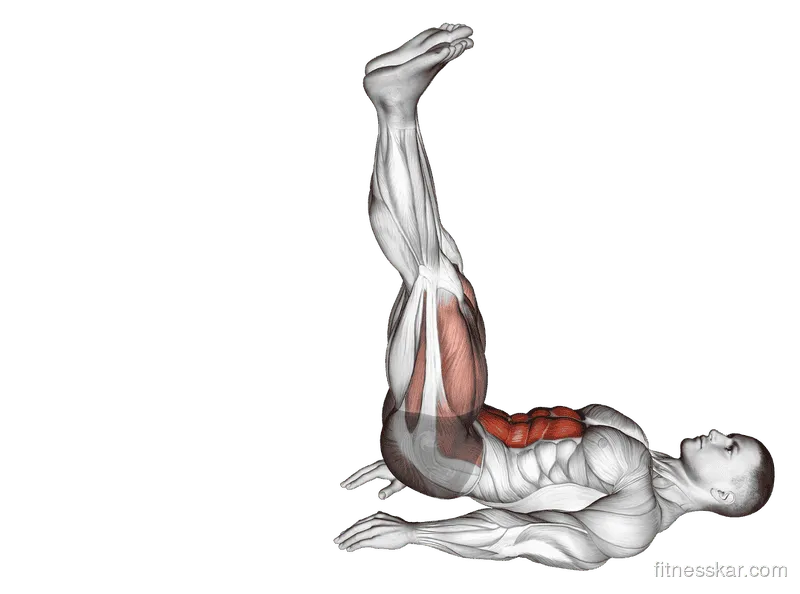
Lying Leg Raise
Lie flat on your back with legs extended and arms at your sides, palms down. Keeping your legs straight and together, slowly lift them toward the ceiling until they are perpendicular to your torso, then lower them back down without letting your feet touch the floor. Engage your core throughout to prevent your lower back from arching.
- Target muscles
- Lower abs
- Also works
- Upper abs, Obliques, Hip Flexors
- Equipment
- Bodyweight
- Training style
- Calisthenics, Home, Gym-based
- Logged as
- Reps
- Popularity
- 85 of 100
Lying Leg Raise: how to do it
- Lie flat on your back on the floor or a mat with your legs fully extended and your arms at your sides, palms facing down.
- Keep your legs straight and together, and slowly lift them upward until they form a 90-degree angle with your torso. Your feet should be pointing toward the ceiling.
- Engage your core muscles throughout the movement to avoid arching your lower back.
- Slowly lower your legs back down to the starting position, keeping them straight and controlled. Do not let your feet touch the ground to maintain tension in your abdominal muscles.
- Repeat the movement for the desired number of repetitions.
Common mistakes
A common mistake is arching the lower back, which can cause discomfort or injury. To avoid this, keep your core engaged throughout the movement and lower your legs slowly without letting your feet touch the floor.
Alternatives
More Lower abs exercises






Questions about Lying Leg Raise
Which muscles do lying leg raises work?
Lying leg raises primarily target the lower abs, helping strengthen and define the lower portion of your core. They also engage the upper abs, obliques, and hip flexors as secondary muscles for overall core stability.
Do lying leg raises require any equipment?
No equipment is required for lying leg raises, making them perfect for home workouts and gym routines. You only need a flat surface like a mat to perform them comfortably, though adding ankle weights can increase difficulty.
Are lying leg raises suitable for beginners?
Yes, beginners can perform lying leg raises if they maintain proper form and avoid excessive strain on the lower back. If full leg raises feel too challenging, start by bending your knees slightly or performing bent-knee leg raises.
What are common mistakes when doing lying leg raises?
A common mistake is arching the lower back, which can cause discomfort or injury. To avoid this, keep your core engaged throughout the movement and lower your legs slowly without letting your feet touch the floor.
How many sets and reps should I do for lying leg raises?
For general core strength, perform 3 sets of 10–15 reps with controlled movements. If your goal is endurance or toning, you can increase to 20 reps per set while maintaining strict form.
What safety tips should I follow when doing lying leg raises?
Always keep your lower back pressed into the mat to avoid strain and move your legs slowly to maintain control. Stop immediately if you feel sharp pain, and consider warming up your core before starting.
What variations can I try to make lying leg raises harder?
You can add difficulty with ankle weights, perform leg raises on a decline bench, or incorporate a stability ball between your feet. Advanced users may also try hanging leg raises for greater core activation.