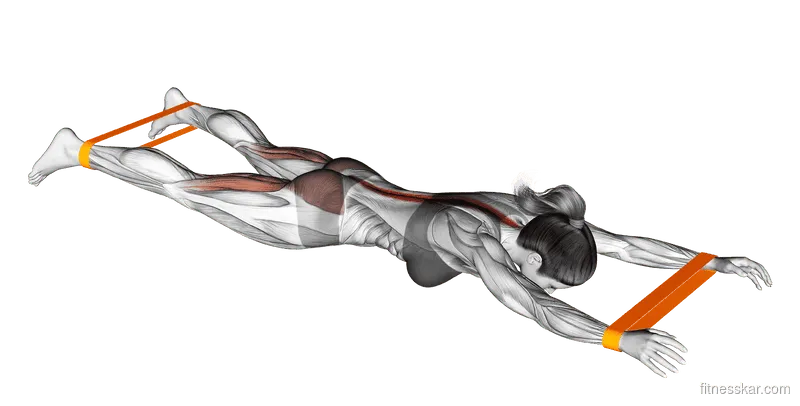
 Start
Start
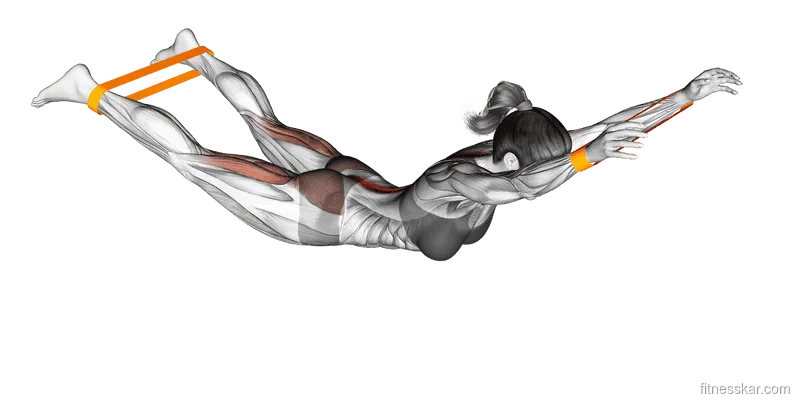 Finish
Resistance Band Floor Hyperextension
Lie face down with a resistance band around your wrists and ankles, arms extended overhead and legs straight. Engage your core and glutes, then lift your arms, chest, and legs off the floor simultaneously, keeping your neck neutral. Pause briefly at the top, then lower back down with control.
- Target muscles
- Lower back, Glutes
- Also works
- Shoulders, Upper back
- Equipment
- Resistance bands
- Training style
- Home, Calisthenics, Mobility and recovery
- Logged as
- Reps
- Popularity
- 75 of 100
Resistance Band Floor Hyperextension: how to do it
- Begin by lying face down on the floor in a prone position. Place a resistance band around your wrists and ankles, ensuring it is taut but not overly stretched.
- Extend your arms straight out in front of you and your legs straight behind you, keeping your body in a neutral position.
- Engage your core and glutes as you prepare to lift.
- Simultaneously lift your arms, chest, and legs off the ground as high as possible, creating a hyperextension in your back. Keep your neck in a neutral position and avoid straining it.
- Hold the top position for a brief moment, feeling the contraction in your lower back, glutes, and shoulders.
- Slowly lower your arms, chest, and legs back to the starting position in a controlled manner.
- Repeat for the desired number of repetitions.
Common mistakes
Avoid arching your neck excessively or jerking your movements, as this can strain your spine. Another common mistake is letting your core disengage, which reduces effectiveness and may lead to lower back discomfort.
Alternatives
More Lower back exercises



Questions about Resistance Band Floor Hyperextension
What muscles does the Resistance Band Floor Hyperextension target?
This exercise primarily works the lower back and glutes, helping to strengthen your posterior chain. It also engages the shoulders and upper back as secondary muscles, offering a balanced strengthening effect for your back and core stability.
Do I need special equipment for the Resistance Band Floor Hyperextension?
A resistance band is the only essential piece of equipment for this move, ideally a medium-strength band for controlled tension. If you don’t have a band, you can perform a bodyweight floor hyperextension, though it will provide less resistance and muscle activation.
Is the Resistance Band Floor Hyperextension suitable for beginners?
Yes, beginners can safely perform this exercise, especially if they use a lighter resistance band and focus on proper form. Starting with slow, controlled movements helps build strength in the lower back before progressing to more intense variations.
What are common mistakes to avoid with Resistance Band Floor Hyperextensions?
Avoid arching your neck excessively or jerking your movements, as this can strain your spine. Another common mistake is letting your core disengage, which reduces effectiveness and may lead to lower back discomfort.
How many sets and reps should I do for Resistance Band Floor Hyperextensions?
A good starting point is 3 sets of 10–15 controlled reps, focusing on quality over speed. If performing for endurance or mobility work, you can hold each lift for 3–5 seconds before lowering.
Are there safety considerations for the Resistance Band Floor Hyperextension?
Always keep your neck neutral and avoid sudden movements to protect your spine. If you have lower back issues, consult with a fitness or medical professional before adding this exercise to your routine.
What variations can I try for the Resistance Band Floor Hyperextension?
You can increase intensity by using a heavier resistance band or adding pulses at the top of each lift. For a gentler version, perform the movement without bands or lift only your chest or legs to focus on specific muscle groups.