The standing barbell overhead press—often revered as the military press—is the definitive benchmark of upper-body vertical pushing strength. While modern lifters frequently prioritize horizontal pressing on the bench, no exercise tests total-body neuromuscular coordination, shoulder durability, and structural core stability quite like pressing a heavy barbell directly overhead. Executed correctly, the overhead press builds dense deltoids, thick upper trapezius fibers, rugged triceps, and an unyielding core, all while fostering resilient, healthy shoulder joints.
Despite its simplicity on paper, pressing heavy iron overhead is unforgiving. Without the external support of a bench, any technical breakdown—such as improper elbow positioning, a curved bar path, soft glutes, or excessive lumbar arching—leaks kinetic energy and stalls your strength progress. By mastering bar path mechanics, harnessing proper scapulohumeral rhythm, and applying systematic progressive overload, you can transform the overhead press into one of your most dominant and rewarding compound lifts.
Functional anatomy and biomechanics of vertical pressing
Understanding which muscles drive the overhead press enables you to diagnose technical sticking points and program effective accessory movements. While commonly perceived as an isolated shoulder exercise, the standing overhead press is a closed-chain kinetic movement that recruits muscular contractions from your feet to your fingertips.
Scapulohumeral rhythm and joint health
A critical biomechanical difference between the barbell overhead press and the bench press lies in scapular movement. During a bench press, your shoulder blades remain retracted, depressed, and pinned firmly against the upholstery. During an overhead press, however, your shoulder blades must move freely through a coordinated kinematic pattern known as scapulohumeral rhythm.
As your humerus (upper arm bone) elevates beyond 30 degrees of abduction, your scapula must rotate upward in a 2:1 ratio of humeral elevation to scapular rotation. When you reach the top of the press, actively shrugging your shoulders upward engages the serratus anterior and upper trapezius. This upward rotation tilts the acromion process away from the humeral head, expanding the subacromial space. This mechanical clearance allows the supraspinatus tendon of the rotator cuff to pass freely without pinching, making the strict overhead press remarkably safe and protective for healthy shoulder anatomy.
The kinetic chain and the anatomical lifting belt
Because you are standing on the floor with heavy weight suspended overhead, every joint between the barbell and the ground must resist deformation. If your glutes relax or your abdominal wall softens, your pelvis tilts anteriorly. This forces your lumbar spine into hyperextension, converting the vertical press into an awkward, standing incline bench press. This postural flaw places high shear stress across the lumbar vertebrae while dissipating vertical drive. Squeezing your glutes and tightening your core creates an unbreakable base of support that transfers maximum force into the barbell.
The science: muscle activation across pressing variations
Exercise scientists have long evaluated how body position and equipment choice affect shoulder activation and spinal demands during vertical pressing movements. In a landmark electromyographic (EMG) investigation, researchers analyzed muscle recruitment in resistance-trained athletes across standing barbell presses, seated barbell presses, standing dumbbell presses, and seated dumbbell presses.[1]
The data demonstrates that if your primary training goal is building absolute pressing strength and functional athletic durability, the standing barbell press remains unmatched. However, incorporating accessory movements like the Seated Barbell Overhead Press or Dumbbell Standing Overhead Press offers tremendous supplementary value for targeted hypertrophy without excessive spinal fatigue.
How to overhead press: step-by-step technical blueprint
Executing a flawless overhead press requires consistent setup mechanics. Do not approach the rack casually; approach every repetition with deliberate ritual and tension.
1. Rack height and grip placement
Set the barbell in a power rack or squat stand at approximately mid-chest height (between the armpit and nipple line). Setting the bar too high forces you to perform an unstable calf-raise to unrack and rerack the bar, which becomes dangerous under heavy loads.
Approach the bar and grip it just outside your shoulders. For the vast majority of lifters, this places the hands about 1 to 2 inches (2.5 to 5 cm) wider than shoulder width. If your grip is too wide, your forearms will flare outward, shortening your vertical reach and diminishing mechanical leverage off your chest. If your grip is too narrow, your elbows will pinch inward, crowding your shoulders and restricting triceps power.
2. The front rack shelf and elbow angle
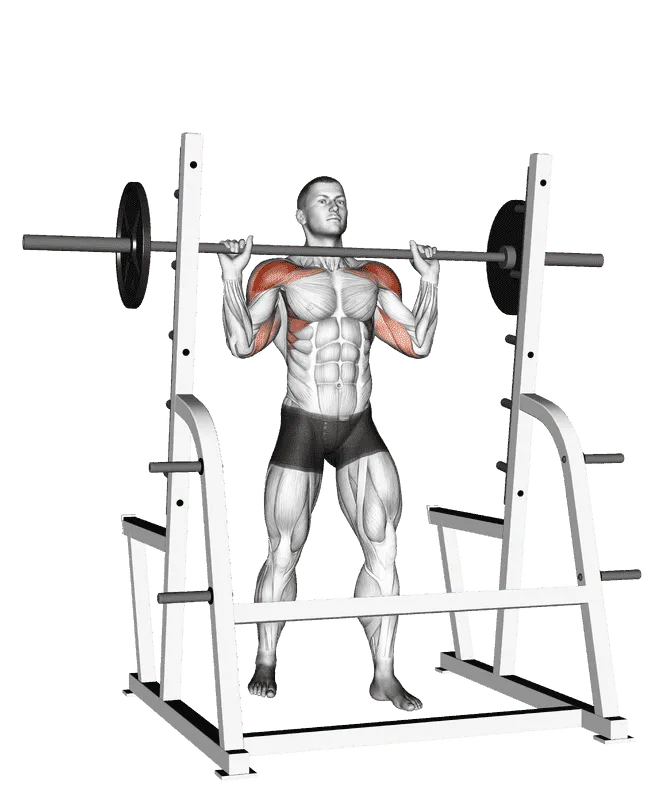
Step under the bar and rest it across your anterior deltoids and upper clavicles. Unlike the deep wrist extension seen in an Olympic weightlifting clean rack position, your wrists in the overhead press should remain nearly straight (with only a slight, natural extension of 10 to 15 degrees).
Position your elbows slightly in front of the barbell—not tucked completely underneath it, and never pointed backward behind it. When viewed from the side, your forearms should form vertical plumb lines perpendicular to the floor. This forward elbow pitch pre-loads the anterior deltoids and latissimus dorsi, giving you an explosive launching pad off the chest.
3. Stance foundation and pre-press bracing
Unrack the bar by taking a small quarter-squat and standing up tall. Take two deliberate steps backward. Set your feet hip-width apart (slightly narrower than your squat stance), with your toes pointed either straight ahead or flared outward up to 15 degrees. Screw your feet into the floor to activate your hip rotators.
Before you press, establish whole-body intra-abdominal pressure:
- Take a deep diaphragmatic breath into your belly and lower back (the Valsalva maneuver).
- Clench your jaw and brace your core as if preparing to take a punch.
- Squeeze your gluteal muscles with maximum voluntary contraction to lock your pelvis in neutral alignment.
- Flex your quadriceps to pull your kneecaps up, ensuring your legs remain completely straight and rigid.

- Sets
- 3–4
- Reps
- 5–8
- Rest
- 150 s
- Tempo
- 2–1–1
4. The vertical bar path and head clearance
The ideal bar path for an overhead press is a straight vertical line ascending directly over your midfoot. However, your head occupies that exact vertical space. To solve this geometric dilemma, you must move your head around the barbell—never swing the barbell forward around your head.
As you initiate the drive, pull your chin straight back into your neck (creating a "double chin") and lean your upper thoracic spine backward slightly from the chest (not from the lower back). Explode upward, driving the bar off your clavicles. The bar should travel millimeters past your nose and forehead.
5. Head through the window and lockout
The moment the barbell clears the top of your forehead, push your head and torso forward back to a neutral, upright position. This coaching cue is known as "putting your head through the window."
Continue driving the bar skyward until your elbows reach complete extension. At the top of the lift, actively shrug your shoulders upward toward your ears to engage your upper trapezius and serratus anterior. At full lockout, your wrists, elbows, shoulders, hips, and midfoot should align in a single, balanced vertical axis. Exhale smoothly through pursed lips, take another breath at the top, and lower the bar under strict control back to your collarbone over a 2-second eccentric tempo (tempo: 2-1-1).
| Phase | Technical Cue | Key Muscle Focus | Common Mistake to Avoid |
|---|---|---|---|
| Grip & Setup | Bulldog grip, forearms vertical | Forearm flexors, wrists | Bending wrists 90° backward |
| Rack Position | Bar on collarbone, elbows slightly forward | Anterior deltoids, lats | Letting elbows drop behind the bar |
| Bracing | Squeeze glutes, clamp abs, lock knees | Gluteus maximus, core | Soft knees, loose pelvis |
| Ascent | Pull chin back, drive bar in straight line | Deltoids, triceps, upper chest | Sweeping the bar forward around face |
| Lockout | Push head through window, active shrug | Serratus anterior, upper traps | Leaving bar out in front of the body |
The 5 critical technique mistakes and how to fix them
Because the standing overhead press operates with zero external back support, technical compensations happen quickly when fatigue sets in. Eliminate these five common mistakes to safeguard your spine and keep your pressing numbers climbing.
1. Excessive lumbar hyperextension
When the weight feels heavy, the body instinctively seeks greater contribution from the larger sternal head of the pectoralis major. To recruit these chest fibers, lifters often lean their upper body backward, arching violently through the lower back. This turns the vertical press into a compromised, standing incline press.
While a slight thoracic extension (arching through the upper ribcage) is natural and necessary to clear the chin, lumbar extension is hazardous. It jams the posterior facet joints of the lower vertebrae and compresses spinal discs under heavy axial load.
The Fix: Think "ribcage down and glutes locked." Before starting the press, actively pull your front lower ribs down toward your hip bones using your rectus abdominis, then contract your glutes as hard as possible. If your glutes remain fully clenched throughout the rep, your pelvis cannot tilt anteriorly, physically preventing your lumbar spine from over-arching. If you cannot maintain this neutral alignment, reduce the load on the bar.
2. Pressing the bar in a wide forward loop
If you fail to retract your head, your nervous system will push the barbell forward away from your face to avoid hitting your nose and chin. This creates a curved, J-shaped bar path.
In physics, force multiplied by the distance of the lever arm equals torque. The further the barbell drifts forward away from your center of mass (the midfoot), the longer the external moment arm becomes. This forward drift places massive, unnecessary shear stress on the anterior shoulder capsule and dramatically reduces your pressing leverage, causing you to fail reps that you could easily complete with a vertical trajectory.
The Fix: Master the double chin. Before you press, pull your head straight back as if pulling away from a bad smell. Keep the bar path completely vertical. As soon as the knurling passes your hair line, smoothly glide your torso forward underneath the bar.
3. Dropping the elbows behind the bar
During the rack position, some lifters let their elbows drop straight down or point backward behind the bar. When you press from this compromised angle, the initial contraction of the triceps pushes the barbell forward rather than upward, worsening the forward bar path loop.
The Fix: Keep your elbows 1 to 2 inches in front of the barbell in the bottom position. This mechanical setup directs the force of your triceps and deltoids straight upward into the bar from the very first millimeter of movement.
4. Turning the strict press into a push press
A strict overhead press relies exclusively on upper-body muscular strength. Many lifters inadvertently dip their knees and use a dynamic leg drive to heave the weight off their shoulders. While the push press is an exceptional athletic exercise, using leg drive on a strict press masks technical weaknesses and robs your shoulders of the intended mechanical tension.
The Fix: Lock your knees tight. Squeeze your quadriceps hard at the start of every repetition. Imagine your lower body is cemented into the gym floor. If your knees bend even an inch during the ascent, that repetition does not count as a strict press.
5. Finishing with the bar out in front of the body
At the top of the repetition, the barbell should finish directly above the base of your neck and the midfoot, balanced over your skeletal frame. Finishing with the bar floating out in front of your forehead forces your front deltoids to support the load isometrically, fatiguing the shoulders prematurely and threatening balance.
The Fix: Push your head through the window and shrug your shoulders up to touch your ears. When you reach full lockout, your ears should be slightly in front of your upper arms (biceps next to ears), not behind them.
Progressive overload and programming for the overhead press
Progressing on the overhead press requires a distinct strategy compared to the squat or deadlift. Because the deltoids and triceps are smaller muscle groups, attempting to add 2.5 kg (5 lb) to the barbell each week will quickly lead to stalled progress and frustration.
The microloading imperative
To achieve continuous, long-term strength gains on the overhead press, invest in a pair of fractional plates (0.25 kg, 0.5 kg, and 1 kg plates). Adding 1 kg (2.2 lb) or even 0.5 kg (1.1 lb) to the bar each week allows your nervous system and shoulder musculature to adapt smoothly without breaking your technical groove. Over a 12-week training block, a 1 kg bi-weekly progression yields a 6 kg (13.2 lb) increase on your overhead press—a massive transformation on a strict vertical lift.
Dynamic double progression model
Rather than forcing weight increases on every workout, use dynamic double progression within a dedicated rep bracket (such as 3 sets of 5 to 8 reps):
- Choose a starting weight you can press for 3 sets of 5 reps with 2 reps in reserve (RIR).
- Keep the weight identical across sessions until you can complete all 3 sets for 8 clean, crisp repetitions with strict form.
- Once you achieve 3 × 8, increase the load by 1 to 2 kg (2 to 5 lb).
- Your rep count will naturally drop back down to approximately 5 or 6 reps with the new weight. Work your way back up to 3 × 8 before making the next weight jump.
Strategic accessory exercises
To build a colossal overhead press, support your primary barbell work with targeted accessory variations that shore up specific sticking points:
Overhead pressing assistance arsenal
-
1 Barbell Standing Military Press - Sets
- 4
- Reps
- 5–6
- Rest
- 180 s
-

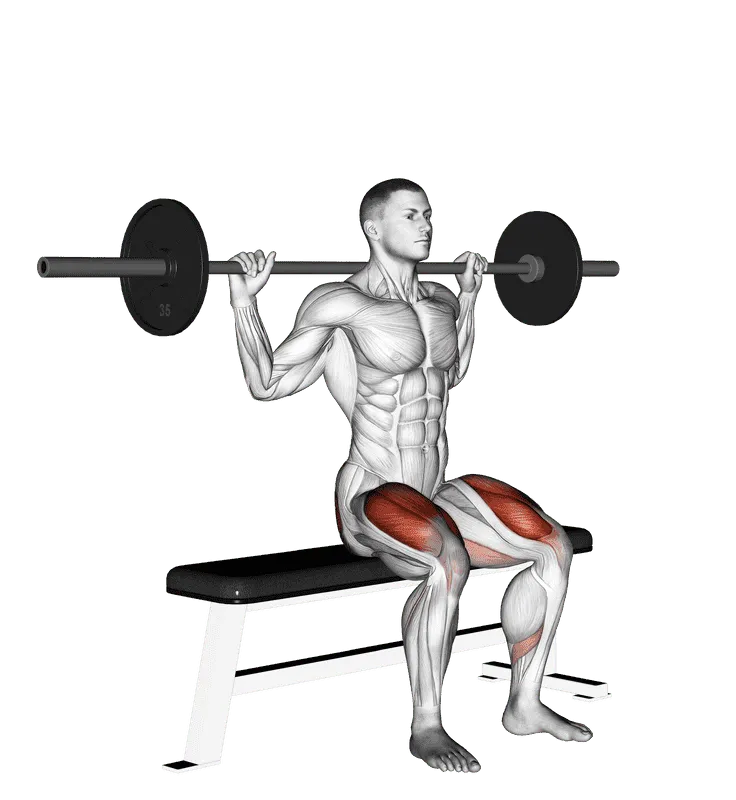
2 Seated Barbell Overhead Press - Sets
- 3
- Reps
- 8–10
- Rest
- 120 s
-
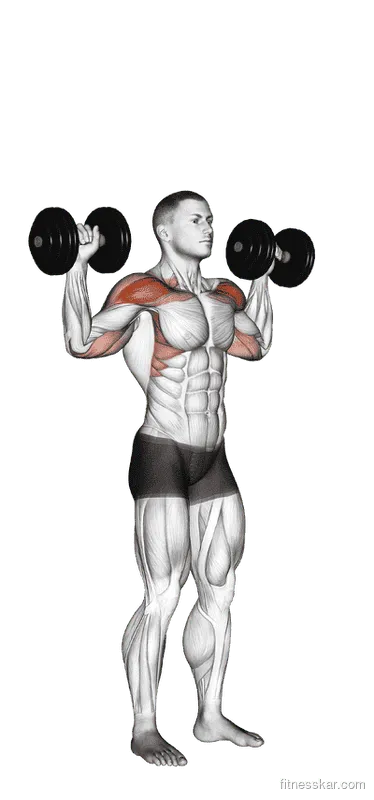
3 Dumbbell Standing Overhead Press - Sets
- 3
- Reps
- 10–12
- Rest
- 90 s
-
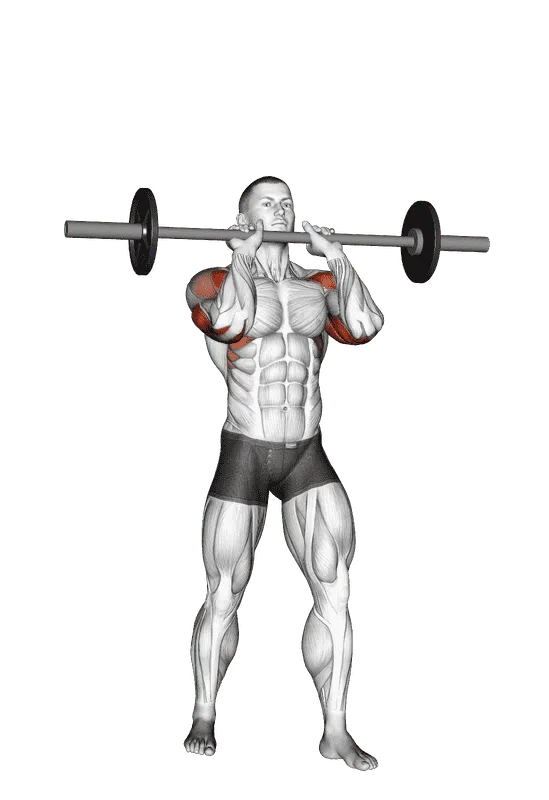
4 Barbell Standing Close-Grip Military Press - Sets
- 3
- Reps
- 6–8
- Rest
- 120 s
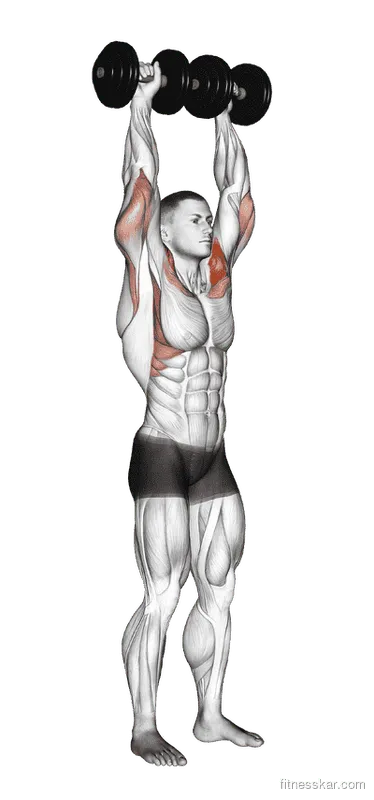
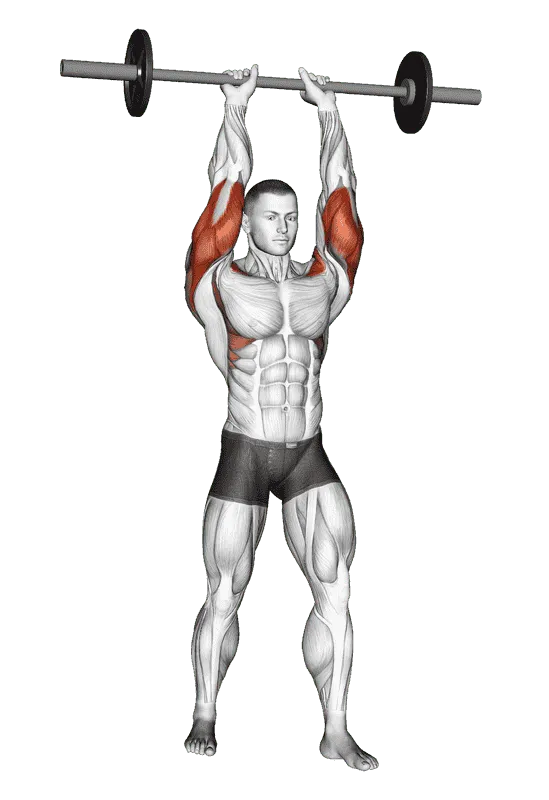
For comprehensive shoulder hypertrophy, combine your heavy vertical pressing with isolation work from our best shoulder exercises guide, and explore structured upper-body splits in our upper-lower split guide to manage systemic fatigue effectively.
One-rep max calculator
(Epley , Brzycki )
| % of 1RM | Load |
|---|---|
Estimates are most accurate between 2 and 10 reps. Test a true 1RM only with a spotter and a proper warm-up.
Frequently asked questions
What is the difference between an overhead press and a military press?
Historically, a military press was performed with the heels clicked tightly together in military attention, requiring extreme balance and core tension. In modern strength training, the terms are used interchangeably, though a standard overhead press uses a slightly wider, more stable hip-width stance.
Is the overhead press bad for your shoulders?
No. When performed with proper technique, the overhead press is protective for shoulder health. Actively shrugging the shoulders upward at lockout engages the serratus anterior and upper trapezius, rotating the scapula and expanding the subacromial space to prevent impingement.
Should I press seated or standing?
Standing is superior for total-body strength, core stabilization, and athletic transfer. Seated pressing eliminates balance demands, making it a valuable hypertrophy accessory when you want to isolate the deltoids with less lower-body and spinal fatigue.
What should I do if my overhead press is stuck at a plateau?
Use fractional microloading plates (0.5 kg to 1 kg jumps), switch to a dynamic double progression model (e.g., 5 to 8 reps), and strengthen your triceps lockout and upper back with close-grip presses and heavy rows.
Sources
- Saeterbakken AH, Fimland MS. Effects of body position and loading modality on muscle activity and strength in shoulder presses. Journal of Strength and Conditioning Research. 2013. doi.org/10.1519/JSC.0b013e318276b873 ↩